Hey science teachers! One of the most common questions we get in the science classroom is about the difference between theories and laws. These terms are fundamental to understanding science, yet they’re often confused by students (and sometimes adults, too!). Let’s break them down and explore how to effectively teach these concepts in the high school classroom.
There is a free downloadable poster for teaching the difference between theories and laws in this blog post for you!
Build Understanding with Reading, Practice, and a Graphic Organizer
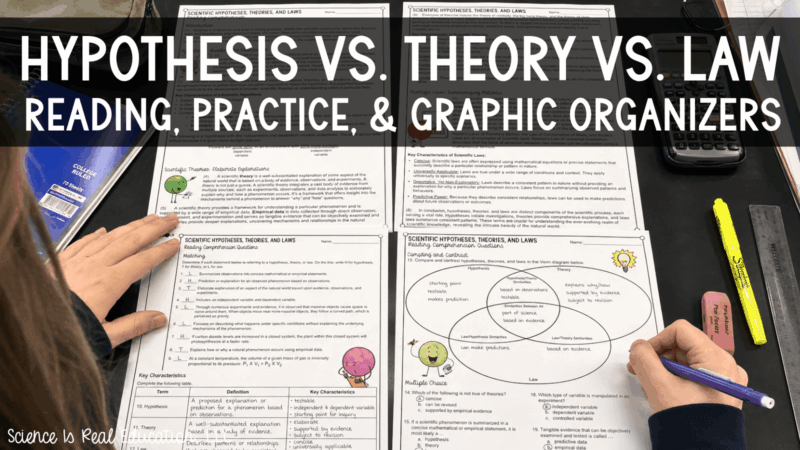
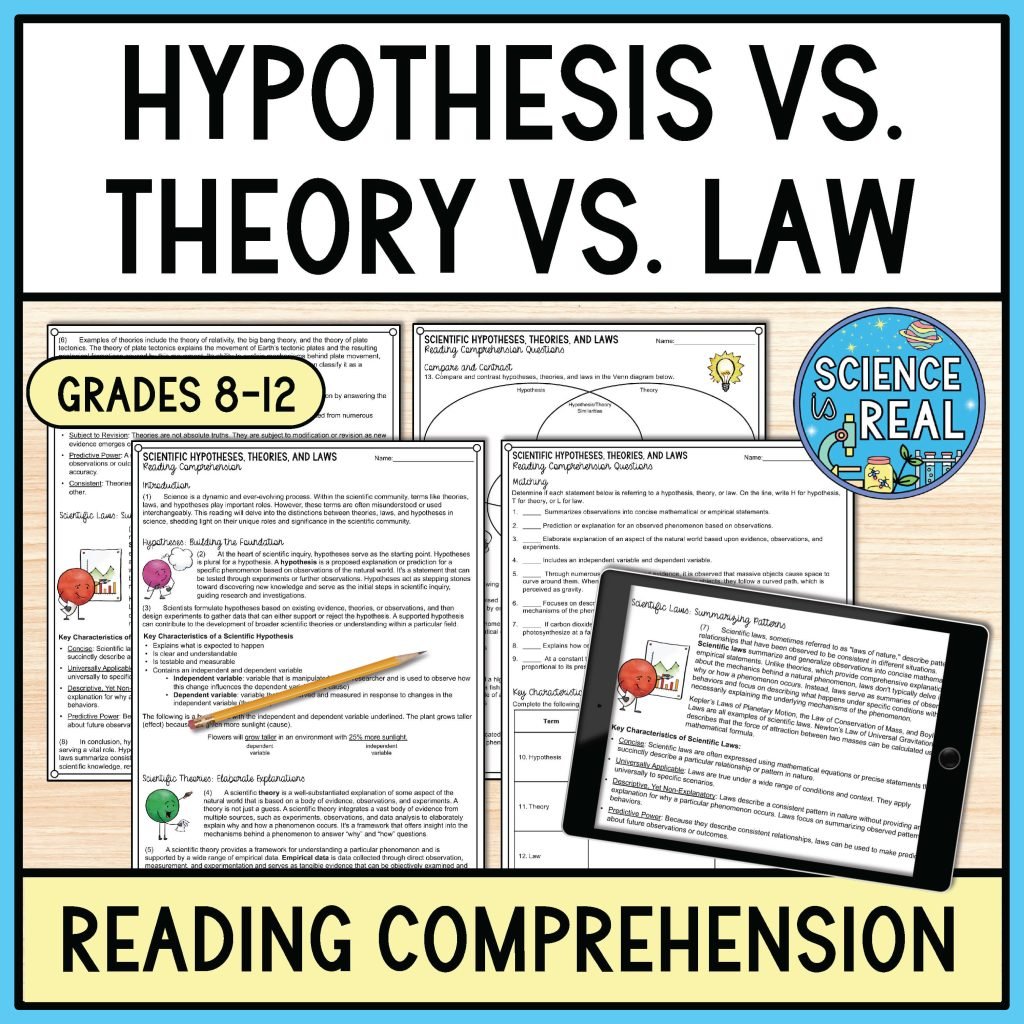
Give students a clear, no-prep way to understand the differences between scientific hypotheses, theories, and laws. This reading and practice activity combines an informative article with text-dependent questions and a graphic organizer so students can build understanding and apply what they learned independently.
- 2-page student-friendly reading
- Text-dependent practice questions
- Graphic organizer and Venn diagram
- Multiple-choice and matching questions
- Answer keys included
- PDF and Google Slides versions
- Full-color and black-and-white options
Teaching Scientific Theories
A scientific theory is a well-substantiated explanation of an aspect of the natural world that is based on a body of evidence and has stood the test of time through multiple lines of inquiry and experimentation.
Key Features of Theories:
- Evidence-Based: Theories are supported by a large body of evidence gathered from multiple experiments and observations.
- Explanatory Power: They explain how and why certain phenomena occur.
- Predictive Power: Theories can be used to make predictions about future observations.
- Revisable: They can be modified or refined as new evidence becomes available.
Example: The Theory of Evolution explains the diversity of life on Earth and is supported by evidence from fields such as genetics, paleontology, and comparative anatomy.
Tips for Teaching Scientific Theories:
- Use Analogies: Compare a scientific theory to a comprehensive book that explains everything we know about a topic, but with room for new chapters as we learn more.
- Highlight Examples: Discuss well-known theories like the Theory of Relativity or the Germ Theory of Disease, emphasizing their broad acceptance and predictive power.
- Engage with Evidence: Have students look at the evidence supporting these theories, perhaps through research projects or interactive timelines showing key discoveries.
Teaching SCIENTIFIC LAWS
A scientific law is a statement that describes a consistently observed phenomenon or a relationship in nature. Laws are typically expressed mathematically and describe what happens under certain conditions.
Key Features OF LAWS:
- Descriptive Nature: Laws describe what happens but don’t explain why it happens.
- Universal Acceptance: They are universally accepted as true and apply consistently across different situations.
- Predictability: Laws allow scientists to predict the outcomes of certain conditions reliably.
Example: Newton’s Law of Universal Gravitation describes the gravitational attraction between two masses but does not explain the mechanism of gravity.
Teaching Tips FOR SCIENTIFIC LAWS:
- Mathematical Formulas: Use equations and formulas to illustrate how laws can predict outcomes (e.g., using Newton’s Laws to predict the motion of objects).
- Consistent Patterns: Show how laws apply universally, using examples from everyday life (e.g., the law of conservation of mass in chemical reactions).
- Hands-On Activities: Conduct experiments that demonstrate these laws in action, helping students see their consistent and predictable nature.
Reinforce Theory vs. Law with a Video Handout
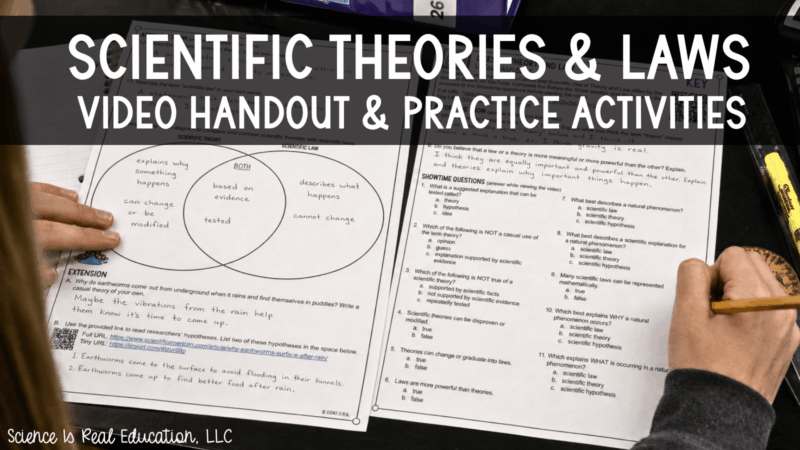
Help students understand the difference between scientific theories and scientific laws with this ready-to-use video handout designed to accompany the Amoeba Sisters Casual and Scientific Uses of Theory and Law video. Students activate prior knowledge, answer questions as they watch, and then apply what they learned through independent practice and an optional extension.
- 2-page video handout
- Before-the-video hook questions
- Multiple-choice questions in video order
- Theory vs. law Venn diagram and practice
- Optional extension activity
- Answer key included
- PDF and Google Slides versions
- Clickable links and QR code for easy video access

Key Differences Between Theories and Laws
When you are teaching the difference between theories and laws, consider the following key points:
- Theories explain why phenomena occur; laws describe what happens.
- Theories are broader and provide deeper explanations; laws are specific and often mathematical.
- Theories can evolve with new evidence, while laws tend to remain consistent as long as the conditions are met.
- Both laws and theories are based on hypotheses. They can be used to make predictions, and both can be revised if necessary.
Hands-On Theory vs. Law Card Sort
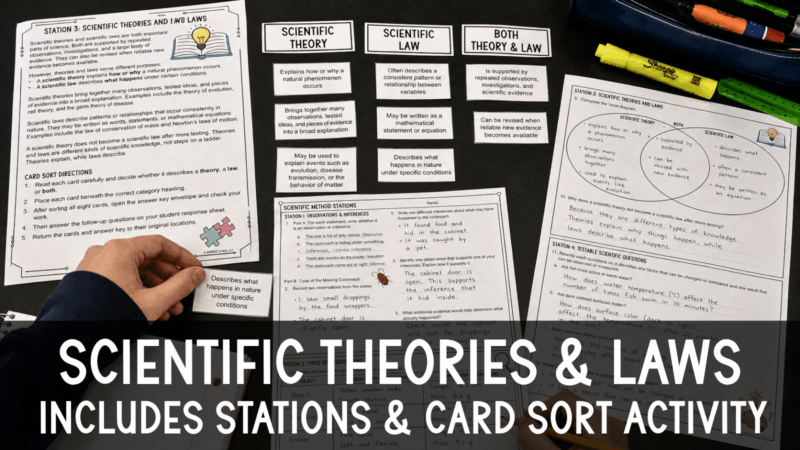
Take the concept beyond a worksheet with these 12 Scientific Method Stations that get students moving, collaborating, and applying important science practices. The Scientific Theories and Laws station is especially useful for this lesson: students compare the two, sort characteristics into theory, law, or both, check their reasoning, and answer follow-up questions. The remaining stations extend the lesson into the broader skills students will use all year, including observations, hypotheses, variables, experimental design, data analysis, CER, and evaluating evidence.
- 12 interactive, text-dependent science stations
- Theory vs. law reading and card sort
- Hands-on tasks, investigation scenarios, data analysis, and CER
- No prior knowledge required
- Printable and Google Slides versions
- Text-editable station cards and student response sheets
- Answer keys and teacher guide included

THEORIES VS. LAWS Activities Around the Web
Here’s a list of my favorite resources for teaching the difference between theories and laws.
TED ED Lesson: What’s the difference between a scientific law and theory?
In this fun free lesson, students watch a fun TED ED video and answer questions as they learn why science needs both laws and theories to understand the whole picture. Bonus – this activity is customizable!
Scientific Theories vs. Scientific Laws CPALMS TutoriaL
In this fun interactive tutorial on the CPALMS website, students will click, learn, and practice information on inferences, hypotheses, variables, and the difference between theories and laws.
Hypothesis vs. Theory vs. Law Open Textbook
In this free textbook chapter, high school students learn the difference between these three concepts in an engaging straightforward way that you can download and print.
Looking for more Nature of Science Lessons? – I got you!