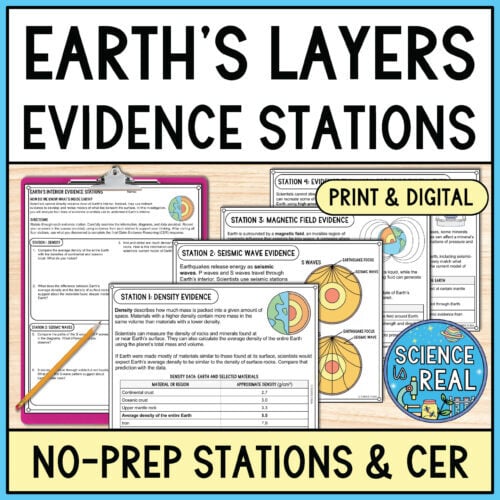
These Earth’s Layers Stations give students a rigorous, evidence-based way to explore how scientists know what is inside Earth.
Rather than simply identifying the crust, mantle, outer core, and inner core, students analyze multiple lines of scientific evidence used to support the current model of Earth’s interior.
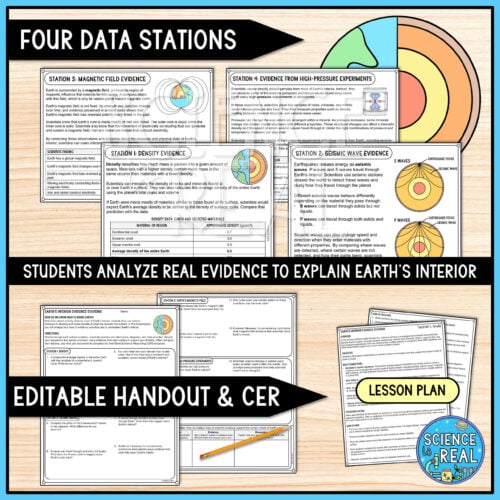
Students investigate density data, seismic waves, Earth’s magnetic field, and high-pressure experiments, then connect what they discover in a final CER response.
This Earth Layers Activity is designed to be used after students have learned the basic structure and properties of Earth’s layers. Students apply that prior knowledge as they interpret scientific observations, make inferences, and explain how evidence supports what scientists know about Earth’s interior.
Evidence for Earth’s Layers Stations Overview:
- Station 1: Density Evidence: Students compare the average density of Earth with the densities of crustal rocks, iron, and nickel. They use the data to infer what the difference in density suggests about materials located deeper inside Earth.
- Station 2: Seismic Wave Evidence: Students analyze diagrams showing how P waves and S waves travel through Earth. They use differences in wave behavior to make inferences about Earth’s layered structure and the liquid outer core.
- Station 3: Magnetic Field Evidence: Students examine evidence related to Earth’s changing magnetic field, magnetic reversals, electrically conducting materials, and the physical states of the inner and outer core. They determine why the liquid outer core best matches the conditions needed to help generate Earth’s magnetic field.
- Station 4: High-Pressure Experiments: Students explore how scientists recreate the extreme pressures and temperatures found deep inside Earth. They analyze how changes in mineral structure, density, melting behavior, and seismic-wave speed can help scientists test and refine models of Earth’s interior.
- Final CER: Students bring multiple lines of evidence together to answer the question, “How do multiple lines of scientific evidence support the current model of Earth’s interior?” Students develop a claim, select specific evidence from different stations, and explain their reasoning.
These Evidence for Earth’s Layers Activities go beyond basic layer identification and memorization. Students are asked to analyze data, interpret scientific evidence, make inferences, and connect multiple observations to a scientific model, making this a great follow-up after teaching the traditional facts about Earth’s layers.
This activity strongly supports NGSS HS-ESS2-3 by helping students analyze evidence used to develop the current model of Earth’s interior and provides important background before students explore thermal convection and matter cycling.
Get these Earth’s layers stations and more in the Growing Earth Science Stations Bundle – on sale now!
Super Low Prep – Print the four station cards and one student response sheet for each student. No special materials or laboratory equipment are required.
Earth’s Layers Stations Download Includes:
- 4 Evidence of Earth’s Layers Station Cards
- 2-Page Editable Student Response Sheet with CER
- Teacher’s Guide and Lesson Plan
- Answer Key with Sample Responses
- PDF and Google Slides Version of the Activity
Pacing – This Earth Layers Activity is designed to take approximately 30–40 minutes for the stations plus 10–15 minutes for the final CER. The CER can be completed during the same class period or used as a follow-up assessment.
MORE EARTH’S LAYERS ACTIVITIES
PURCHASE ON TPT