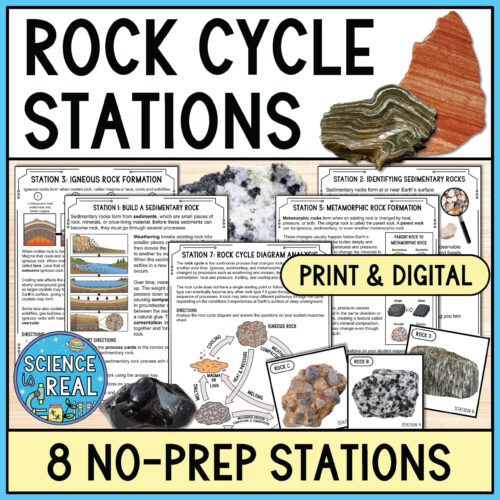
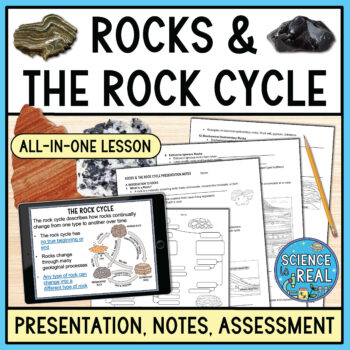
These rocks and rock cycle stations give students a structured, engaging way to explore how rocks form, how they are identified, and how they change through the rock cycle.
No prior knowledge or rocks needed!
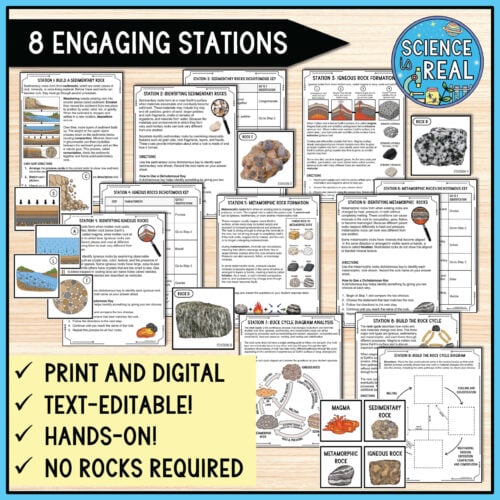
Students explore each topic through short readings, card sorts, dichotomous keys, rock identification, cause-and-effect matching, diagram analysis, and hands-on modeling activities.
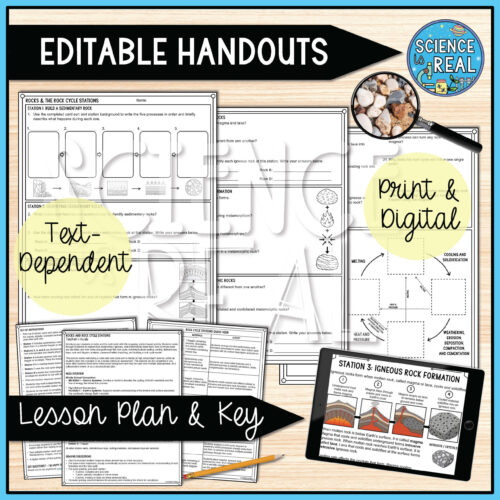
This rocks and rock cycle stations activity includes printable station cards, student response sheets, answer keys, rock picture cards, dichotomous keys, sorting materials, a digital Google Slides version, and a text-editable version for teacher customization.
Every station includes student-friendly background information and is designed to be text-dependent, so students can work through the activity with minimal prior knowledge.
Rocks and Rock Cycle Stations Overview:
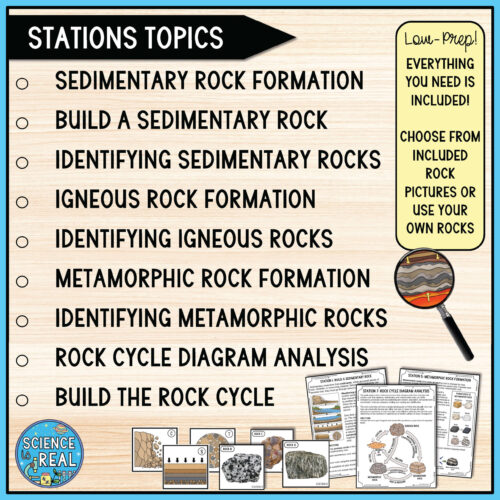
- Station 1: Build a Sedimentary Rock: Students arrange the five sedimentary rock formation processes in order, then match each process with its correct description and picture.
- Station 2: Identifying Sedimentary Rocks: Students use observable features and a dichotomous key to identify sandstone, shale, conglomerate, and limestone using real rock samples or the included picture cards.
- Station 3: Igneous Rock Formation: Students match cause-and-effect cards related to intrusive and extrusive rock formation, cooling rate and crystal size, and vesicle formation.
- Station 4: Identifying Igneous Rocks: Students use observable features and a dichotomous key to identify basalt, diorite, granite, and pumice.
- Station 5: Metamorphic Rock Formation: Students read about how heat and pressure change parent rocks, then answer text-dependent questions about metamorphism, recrystallization, and foliation.
- Station 6: Identifying Metamorphic Rocks: Students use observable features and a dichotomous key to identify slate, gneiss, marble, and schist.
- Station 7: Rock Cycle Diagram Analysis: Students analyze a rock cycle diagram to determine which processes change rocks from one form to another and trace multiple pathways through the cycle.
- Station 8: Build the Rock Cycle: Students place magma, igneous rock, sedimentary rock, and metamorphic rock cards into a partially completed rock cycle model, then use additional pathways to check their reasoning.
This rocks and rock cycle stations activity is a fun way to get students moving, collaborating, identifying rocks, and applying what they know about rock formation and the rock cycle in a variety of meaningful ways.
Super Low Prep!
- Everything is included! Yes, everything. You can use your own rock samples if you’d like, but you don’t have to. High-quality rock pictures are included in your download.
- With the included teacher’s guide and lesson plan, you will receive a stations overview page with each station’s overview and necessary materials needed to be placed at each station. You do not need station signage because each station card is clearly marked with the station number and name.
Rock Cycle Lab Stations Download Includes:
- 8 Stations Cards (text-editable PPT and PDF)
- Student Answer Sheet (text-editable PPT and PDF)
- Teacher’s Guide and Lesson Plan
- Original Content, Diagrams, Card Sorts, and Activities
- Answer Key
- Google Slides Version of the Activity
*This activity is designed to take about one-to-two 50-minute class periods. It is editable to meet your needs and time constraints.
MORE ROCKS AND MINERALS LESSONS
PURCHASE ON TPT