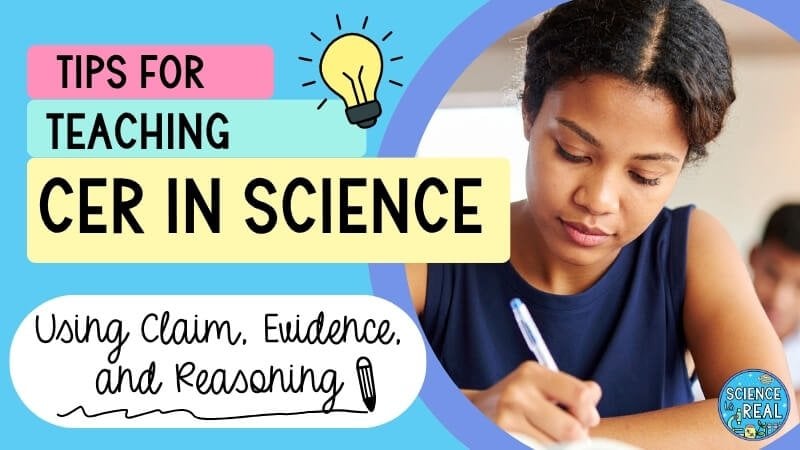
You know that moment when you ask students to explain why their lab results make sense, and they just say, “Because that’s what happened”? We’ve all been there. Helping students move beyond simple answers to real scientific explanations takes practice, and that’s where CER in Science comes in. The Claim, Evidence, Reasoning framework gives students the structure they need to think like scientists and communicate their ideas clearly. In this post, we’ll look at what each part of CER means, why it matters, and how to help students write stronger scientific explanations with confidence.
What is The CER Framework?
The CER in science framework is a simple and powerful way to help students build strong scientific explanations instead of guessing their way through lab questions. Here’s how it works:
- Claim: This is the student’s answer to the question. It’s the big idea or conclusion they are trying to prove. Think of it as their “What I think” statement.
- Evidence: Now comes the proof. Students use data from their experiment, research, or observations to support their claim. This is their “How I know” section.
- Reasoning: This is where the magic happens. Students connect their evidence to their claim using scientific principles or concepts. It’s their chance to explain why the evidence supports the claim and show real understanding of the science behind it.
- Rebuttal or Counterclaim: This final step challenges students to think critically. They consider other possible explanations or viewpoints, then explain why their claim is still the strongest based on the evidence. It helps them strengthen their argument and think like true scientists.
Keep CER front and center all year long with this simple visual reminder set.
If you’re tired of repeating “Don’t forget your reasoning!” during every lab conclusion, these CER in Science anchor chart posters are your new best friend. This 5-poster set breaks down each part of the CER framework—Claim, Evidence, Reasoning, and even Rebuttals—into clear explanations with tips and examples your students will actually understand.
- Hang them on your wall as eye-catching reminders of the CER in science framework
- Give students mini versions for their notebooks so the framework is always within reach
- Use them to guide class discussions and lab write-ups
- Keep them handy for any activity where students need to think and write like scientists

How to Complete Each Part Of the CER In Science Framework

1. Claim
- What it is: A statement that responds directly to the question or problem posed.
- How to do it: Make sure the claim is concise and directly answers the question. Avoid using vague language.
- Guiding Question: Does increasing the amount of sunlight affect the growth rate of plants?
- Example of Claim: Increasing the amount of sunlight increases the growth rate of plants.
2. Evidence
- What it is: Data or observations that support the claim. Evidence should be relevant and sufficient.
- How to do it: Collect data through experiments, research, or observations. Ensure the evidence directly relates to the claim and includes quantitative or qualitative data.
- Example of Evidence: (based on the claim above): In an experiment, plants exposed to 8 hours of sunlight daily grew an average of 5 cm per week, while plants exposed to 4 hours of sunlight grew an average of 2 cm per week.
3. Reasoning
- What it is: The logical connection between the evidence and the claim. It explains why the evidence supports the claim using scientific principles.
- How to do it: Use scientific knowledge to explain why the evidence is relevant and sufficient to support the claim. Make the reasoning clear and logical.
- Example of Reasoning: (based on the claim and evidence above): Plants require sunlight for photosynthesis, the process by which they convert light energy into chemical energy to fuel their growth. The data shows that plants with more sunlight exposure grow faster because they can photosynthesize more effectively, producing more energy for growth. Therefore, the increased growth rate in plants with 8 hours of sunlight supports the claim that more sunlight leads to faster growth.
4. Rebuttal or Counterclaim
- What it is: Acknowledges an opposing viewpoint or potential flaw in the argument and explains why the original claim still makes sense based on the evidence. This helps students think critically and strengthens their scientific reasoning.
- How to do it: Encourage students to consider alternative explanations for their results. They can identify other factors that might influence the outcome, then explain why their evidence still best supports the claim.
- Example of Rebuttal/Counterclaim: (based on all of the above): Some may argue that other factors, such as soil nutrients or water availability, could also affect plant growth. However, in this experiment, all plants received the same soil type and amount of water. The only variable that changed was sunlight exposure, which supports the conclusion that increased sunlight leads to faster growth.
How to Use CER in Science Classrooms
1. Video Analysis and Commercials
Use short clips or commercials to spark curiosity and discussion. Try the Cheryl’s She Shed ad and ask students to make a claim about what caused the fire, use details from the video as evidence, and explain their reasoning. Quick, visual, and always a hit.
2. Data Interpretation
Show students a graph, data table, or experiment summary and have them form a CER based on what they see. It’s a simple way to turn data analysis into real scientific writing practice. You can find amazing free data-based CER problems on the Virtual Science Teachers website here.
3. Science Journals
Add weekly CER in science prompts to analyze science journals. Students can reflect on experiments, connect new ideas to previous lessons, and practice writing in a low-stakes way.
4. Class Discussions
Turn CER writing into conversation. Have students share their claims, challenge each other’s reasoning, and practice defending their ideas using evidence.
5. Make it Tactile This is a fun cut and paste activity! This free worksheet uses examples and non-examples to help students practice their reasoning skills in preparation for writing their own CER statements.
6. Lab Conclusions
Replace traditional lab questions with a CER format. Students write their claim, evidence, reasoning, and rebuttal—building stronger, more consistent lab reports. Check out some of my ready-to-go CER labs below!
CER In Science Labs
-

Volcanoes Lab – Types of Volcanoes Edible CER Lab
$4.99 -

Plate Tectonics Graham Cracker Lab
$5.99 -

Cookie Mining Lab – Fun and Tasty Lab
$3.99 -
Climate Change Reading Comprehension, Graphing Lab, and CER Activities
Original price was: $12.50.$7.99Current price is: $7.99.

Teacher Tips and Tricks for Teaching CER in Science
CER in science can feel intimidating at first, but once students understand the structure, it quickly becomes second nature. The key is to keep it consistent, visual, and meaningful. Here are some teacher-tested ideas to make CER writing smoother and more engaging in your classroom:
- Model, Model, Model: Write a CER response together as a class before asking students to do it on their own. Talk through your thought process and highlight what makes each part strong.
- Use Color-Coding: Assign each part of CER a color. For example, green for Claim, yellow for Evidence, and blue for Reasoning; so students can visualize the structure. This simple strategy works wonders for clarity.
- Keep Sentence Starters Handy: Provide prompts like “I think that…,” “According to the data…,” and “This supports my claim because…” to help students get started. Over time, they’ll begin writing more independently.
- Incorporate CER into Everyday Lessons: Use quick CER in science prompts after videos, labs, or readings so it becomes part of your routine instead of a one-time skill.
- Celebrate Great CERs: Share a few strong student examples (with permission) and discuss what makes them effective. A little recognition goes a long way in building confidence.
- Scaffold Gradually: Start with claim-only responses, then add evidence, reasoning, and finally rebuttals. Breaking it down helps students focus on quality over quantity.
- Connect to Real Science: Use current events or simple demos to help students see how CER mirrors what real scientists do when explaining phenomena.
Once students see that CER isn’t just “another writing task” but a way to think and reason like scientists, they start to take real ownership of their explanations—and that’s when the magic happens.
Bringing it all Together
Teaching CER in science does not have to feel overwhelming. With a little structure, consistency, and creativity, your students will start writing explanations that actually make sense, and you will spend a lot less time saying, “Don’t forget your reasoning!” To make things easier, grab my free CER in Science Toolkit, which includes a student graphic organizer and writing guide, or check out my CER classroom posters to keep key reminders visible all year long.
MORE FUN CER IN SCIENCE ACTIVITIES
-
Characteristics of Life Reading Comprehension, Worksheets, and CER Activities – Are Viruses Alive?
Original price was: $9.99.$6.99Current price is: $6.99. -

CER Amoeba Sisters Video Handout
$3.29 -

Claim, Evidence, Reasoning CER Posters Bundle
$4.99 -

Layers of the Earth Lab – Fun and Tasty Lab
$3.99