Valentine’s Day is a great opportunity to spark curiosity in the science classroom with love-themed lessons that go beyond the usual candy and cards. I’ve teamed up with some amazing science teachers to bring you six Valentine’s Day science activities that make science both fun and relevant to the holiday.
From the chemistry of love and oxytocin’s role in bonding to bird courtship displays and building a model heart, these activities are perfect for middle and high school students. Whether you teach biology, chemistry, or general science, you’ll find creative ways to keep students engaged while reinforcing key scientific concepts. Get ready to bring a little heart (and a lot of science) into your classroom this Valentine’s Day!
1. Science of Love Reading Comprehension
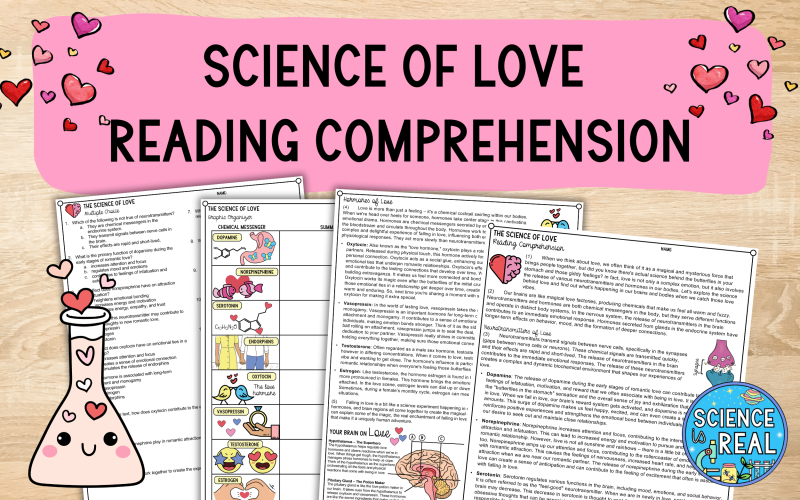
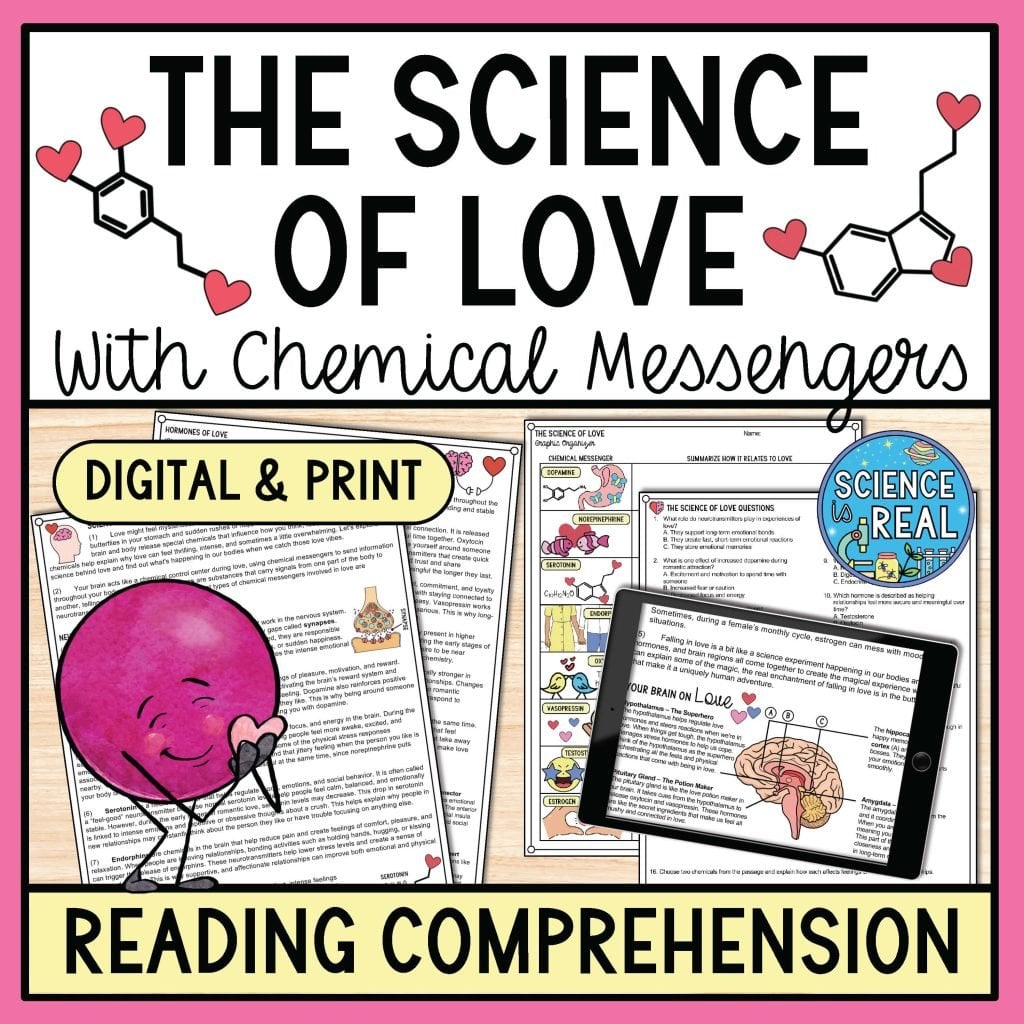
Valentine’s Day is the perfect opportunity to bring a little chemistry—literally—into the classroom! One of my favorite ways to combine science and the season of love is with The Science of Love: Valentine’s Day Reading Comprehension. This activity takes students beyond the usual hearts and flowers and explores the chemical messengers that shape how we fall—and stay—in love.
In this lesson, students explore the fascinating world of neurotransmitters and hormones, learning about the roles of dopamine, serotonin, oxytocin, and more in everything from infatuation to long-term attachment.
The two-page reading introduces them to the differences between neurotransmitters and hormones while breaking down how each plays a role in romantic attraction. After reading, students apply their knowledge through text-dependent questions and a graphic organizer, reinforcing key concepts while engaging with the science behind love.
What I love about this activity is how versatile it is! It’s perfect for a Valentine’s Day-themed science lesson, but it also works well during units on the brain or endocrine system. Plus, since it’s no-prep and ready to use!
It also makes a great sub-plan, homework assignment, or enrichment activity for early finishers.
You can also grab free Valentine’s Day Science Color-By-Number below!
2. Birds of Paradise Courtship Displays Activity

For a Valentine’s Day science lesson that combines biology and creativity, Emma from Emma the Teachie focuses on the elaborate courtship dances of birds of paradise. This engaging lesson teaches students about evolution and sexual selection through the fascinating behaviors of these birds, while giving them a chance to design their own bird of paradise displays.
To start, students engage in a Think-Pair-Share activity. In pairs, they consider questions like:
- What do you already know about courtship rituals?
- Why do animals perform courtship rituals?
- What might these displays signal about the animals?
After sharing ideas with the class, students will watch a video of birds of paradise courtship dances, taking notes on the birds’ movements, colors, and sounds.
Next, Emma leads a class discussion on sexual selection and how these courtship behaviors have evolved over time to signal fitness and attract mates. Afterward, split students into groups to create their own bird of paradise species!
They’ll think about things like color patterns, dances, and sounds, and then present their creations to the class. This can include hand drawn pictures, and even dance performances (for the brave)!
This lesson is a great way to blend animal behavior, evolutionary biology, and hands-on creativity while engaging students in a fun Valentine’s Day-themed activity!
Got a few minutes left to fill? Grab Emma’s free Valentine’s science crossword puzzle to test your students’ general science knowledge!
3. Valentine’s Day Science Stations
Michelle from Secondary Sparks loves the idea of celebrating Valentine’s Day in class but still hitting those standards, especially if you teach a grade level that has standardized testing coming up!
The classroom is set up with 9 different stations that have a Valentine’s Day theme. 3 of the stations focus on Earth/Space standards, 3 of them focus on Life Science standards and 3 focus on Physical Science standards. This provides students with the opportunity to review a variety of topics in 1-2 class periods. This setup ensures students get a well-rounded review of topics they’ve learned throughout the year, all while enjoying the fun of Valentine’s Day and aligning to standards.
Students spend 6-10 minutes at each station and then move on to the next at the sound of a timer. Each station provides a different activity for students that include tasks such as a mini quiz, drawing, a mini lab, research, reading and more.
This Valentine’s Day station activity not only adds a little fun to the classroom but also reinforces essential science concepts in a way that’s interactive and meaningful. It’s the perfect combination of review and celebration, helping students stay on track while still enjoying the holiday!
Check out the Valentine’s Day Science Stations here.
4. Guided Reading on Oxytocin: The Love Hormone

Laney from Laney Lee Science suggests celebrating Valentine’s Day with a science twist by exploring oxytocin, the “love hormone”! This engaging reading activity introduces kids to the amazing world of oxytocin—from its discovery and chemistry to its role in building connections. Known for its role in bonding and social connection, oxytocin is a hormone that plays a key part in everything from childbirth and breastfeeding to the warm, fuzzy feelings we get when we’re with loved ones.
The reading covers how oxytocin works in our bodies and its fascinating role in helping us feel close to others. Students will also learn about ways to naturally increase oxytocin, like spending time with friends, giving hugs, or even just laughing together. To reinforce their understanding, the activity includes comprehension questions to review key concepts and a color-by-number page. Each color corresponds to correct answers, giving students a creative, hands-on way to connect with the material.
This Valentine’s activity is a unique way to learn about the science of connection, helping kids understand that “love” isn’t just a feeling—it’s also chemistry! It’s a fun, informative way to celebrate the season while learning something truly heartwarming.
Get the activity from Laney Lee Science here.
5. For the Love of Naming: Teaching Students Chemical Nomenclature of Ionic Compounds
“Ah, Valentine’s Day…another week in our class where we celebrate love”, says Heather from Science from the South. It’s also around the time when they celebrate their ability to write chemical formulas and practice naming ionic compounds. Heather says, “Chemical nomenclature of ionic compounds can be tricky for middle and high school science students to grasp.” However, practice makes perfect! So, they practice naming ionic compounds until they are experts, following a simple learning path.
First, the students need some background information about the atom, periodic table, and different types of matter from elements and compounds. At this point, they are ready to learn about the various parts of a chemical formula. Up next in the learning path, they learn about ions and how to write chemical formulas. Finally, the students learn how to name ionic compounds using NaCl as an example. When they reach this point, it’s all about practice.
You can read more about the learning path here and get Science from the South’s Naming Ionic Compounds Mystery Picture for FREE.
6. Make Models of the Heart with Recyclables!

Every Valentine’s Day, Jessica from Science of Curiosity likes to remind her students that in Science class, the heart does not look like this: <3!
Instead of making Valentine’s cards with the cupid heart, she provides her students with a pile of recyclable materials and has them build a model of the human heart! Building a model gives them hands-on understanding of how blood flows through the heart’s chambers, valves, and vessels!
This interactive project not only teaches students about anatomy but also taps into their creativity and problem-solving skills! The goal is for students to create a model that includes 12 key parts of the heart: the aorta, vena cava, tricuspid, mitral, aortic and pulmonary valves, pulmonary artery and vein, and the left and right atria and ventricles. They’ll start by sketching a diagram, picking out recyclable materials like plastic bottles, cardboard, straws, and rubber bands, and then get to work assembling their heart.
Jessica at Science of Curiosity offers a FREE project guide for building a heart model – including Student Instructions, heart part labels, photo examples of heart models, and detailed Teacher’s Instructions!
Once they are complete, students share their hearts by taking a photo of them and sending it to their Valentine! They can also send the photo to you to grade 🙂
♥️ Happy Valentine’s Day to you and your students!
This month of love is the perfect time to bring creativity and engagement into your science lessons. Whether your students are exploring the chemistry of love, building heart models, or investigating courtship behaviors, these Valentine’s Day science activities offer a fun and meaningful way to connect science to the holiday. No matter what subject you teach—biology, chemistry, or general science—there’s an activity here to spark curiosity and keep students engaged.
Do you have a favorite Valentine’s Day science activity? We’d love to hear how you celebrate in your classroom! Share your ideas in the comments and let’s keep the love for science going!