Science classroom supplies are not just about beakers, goggles, and dry erase markers. Sometimes the most game-changing tools are the random little things that make your classroom run smoother, help you manage group work, and save you from repeating yourself 47 times in one class period.
After years of teaching science, I have learned that the best classroom supplies are the ones that solve an actual problem. They help you move around the room, keep students on track, manage lab groups, pace activities, and catch small issues before they turn into full-class chaos.
These are some of my favorite science classroom must-haves for middle and high school teachers. They are practical, useful, and chosen because they make real classroom life easier, not because they look cute in a supply bin.
Hear Me Out: A Waitress Apron
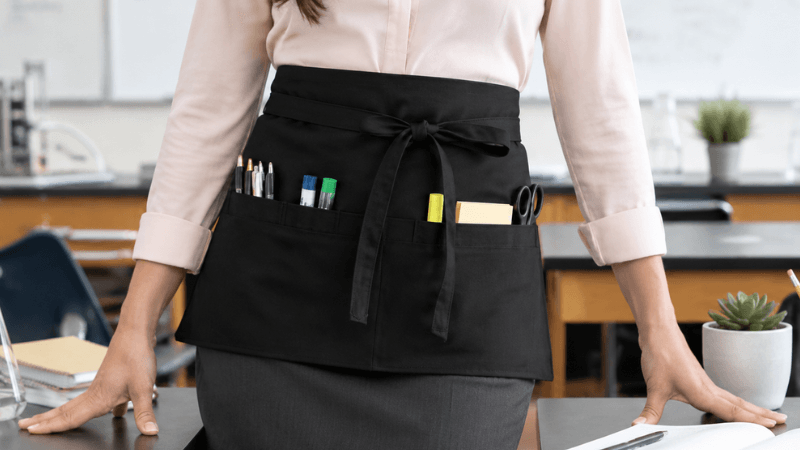
One of my favorite science classroom supplies is something that was absolutely not designed for a science classroom: a waitress apron. It sounds random, but it is one of those game-changing must-haves that makes group work, labs, and stations so much easier to manage.
When I am moving around the room helping students, I do not want to keep walking back to my desk every time someone needs a pencil, highlighter, dry erase marker, sticky note, paper clip, hall pass, or random supply that somehow becomes urgent in the middle of class. A waitress apron lets me keep those small classroom supplies right with me while I circulate.
This is especially helpful in a middle or high school science classroom because so much of what we do involves movement. Students are working in groups, rotating through stations, completing labs, analyzing data, or asking questions from five different corners of the room. Having a few basic supplies on me means I can solve small problems quickly without losing momentum.
A waitress apron can also help with classroom management. When you can stay near student groups instead of constantly going back and forth across the room, you can answer questions faster, check progress more easily, and keep a better pulse on what is happening. They are also fun to personalize with buttons, pins, or even fabric paint so you can match your school colors, team theme, or classroom personality. It is simple, inexpensive, and honestly one of those science teacher supplies I wish I had started using sooner.
Magnetic Mirror for Classroom Awareness
A magnetic mirror is one of those science classroom supplies that sounds a little strange until you use it. I like placing one on the whiteboard so I can see what is happening behind me while I am writing directions, modeling a problem, or adding notes to the board.
This is especially helpful in a middle or high school science classroom because students are not always sitting quietly in rows. They may be working with lab materials, moving between stations, talking through group work, or finishing an activity while you are trying to write the next step. A small magnetic mirror gives you a better sense of the room without constantly turning around.
It is not about “catching” students as much as it is about classroom awareness. When you can see movement, raised hands, side conversations, or groups that look stuck, you can respond faster and keep the lesson moving. It is a simple classroom management tool for teachers, but it can make a big difference in how confidently you manage the room.
Buzzers or Call Bells for Student Help Signals
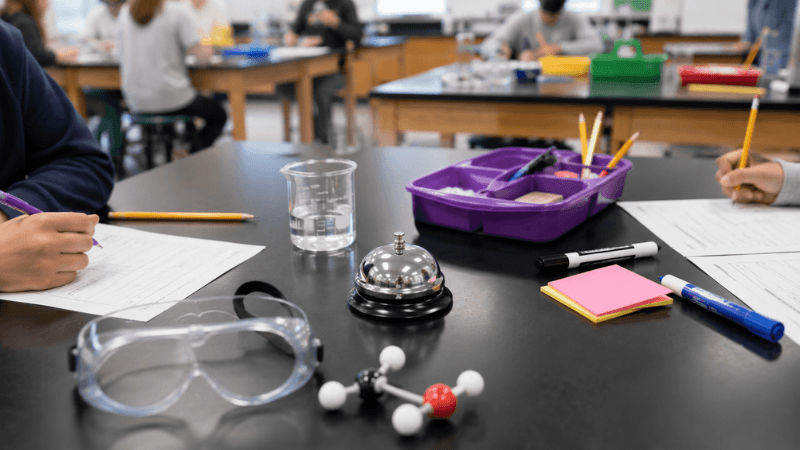
Buzzers or call bells are one of those science classroom must-haves I wish I had known about earlier. During labs, stations, and group work, students often need help at the exact moment you are already working with another group. And if you are across the room with your back turned, it is very easy to miss a raised hand.
The goal is simple: give students an auditory way to signal that they need help. You can place a buzzer, desk bell, or call button at a lab table, group station, or specific area of the room, and students use it when they are stuck, ready for a check, or need teacher support. This works especially well in a busy middle or high school science classroom where students are spread out and you cannot always visually scan every group at once.
It also helps reduce the chorus of your name being called from five different directions. Instead of students calling out or waving you down while you are helping another group, the sound becomes a clear, consistent signal. Used with expectations, buzzers or call bells can be practical classroom management tools that help you respond to groups without interrupting the flow of the whole class.
Large Whiteboards for Small Group Work
Large whiteboards are one of my favorite science classroom supplies for small group work because they give students space to think together. Instead of one student doing all the writing on a worksheet while everyone else quietly “supervises,” a group whiteboard makes the work visible. Students can sketch models, organize evidence, solve problems, plan investigations, build CER responses, or create a quick output to share with the class.
They are also reusable, which makes them especially helpful in a middle or high school science classroom. Students can draft, erase, revise, and try again without wasting a stack of chart paper. I like them for labs, stations, review games, data analysis, vocabulary sorts, claim-evidence-reasoning practice, and any activity where students need to create something together.
If buying a full set of group whiteboards is not in the budget, one common teacher hack is to buy a large white shower board or melamine panel from a home improvement store and have it cut into smaller boards. It will not be quite as polished as a ready-made whiteboard, but it can give you several reusable group work surfaces for a fraction of the cost.
Drawer Organizers for Student Papers
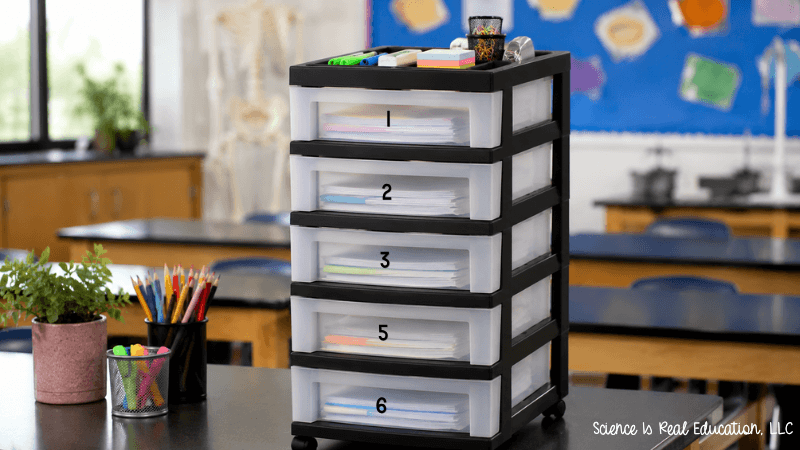
Drawer organizers are one of my favorite science classroom supplies because they solve one of the most annoying teacher problems: the paper pile. I like using two separate drawer towers. One is for papers that students are turning in, and the other is for graded papers that are ready to hand back.
The key is to number or label each drawer by class period. Instead of collecting every paper myself, students place their work directly into the drawer for their period. This keeps papers separated from the start, saves time during transitions, and cuts down on the “Where do I put this?” questions at the end of class.
The second drawer organizer is just as helpful for graded work. Once papers are checked, I sort them back into the correct period drawer until I am ready to return them. This keeps graded papers from getting mixed in with papers that still need to be checked, which is a small classroom management miracle when you teach multiple sections.
This system works especially well in a middle or high school science classroom because you may have several classes doing the same lab, station activity, quiz, or notebook check in one day. Having a clear place for incoming and outgoing papers helps your room feel more organized without needing a complicated system. It is simple, visual, and easy for students to use independently.
Magnetic Timer for Your Whiteboard
A magnetic timer is one of those science classroom supplies that seems simple, but once you start using it, you will find a reason to use it almost every day. I like the kind with large numbers that can stick right to the whiteboard so students can see exactly how much time they have left.
This is helpful for labs, stations, warm-ups, group work, clean-up time, quizzes, transitions, and those “you have three minutes to finish this thought before we move on” moments. In a middle or high school science classroom, pacing matters so much because activities can easily stretch longer than planned. A visible timer helps students manage their time without you having to repeat the countdown every thirty seconds.
It also helps reduce the “How much time do we have?” questions because the answer is right in front of them. Students can glance at the board, adjust their pace, and see that the activity is moving toward an endpoint. As a classroom management tool, it creates a little healthy urgency without you having to be the human stopwatch all period.
I especially like using a magnetic timer during station rotations and lab clean-up. When students can see the time ticking down, transitions tend to feel clearer and less chaotic. It is a small tool, but it makes your science classroom run smoother, especially on days when you are juggling materials, questions, groups, and 47 other tiny teacher decisions.
Standing Podium Desk
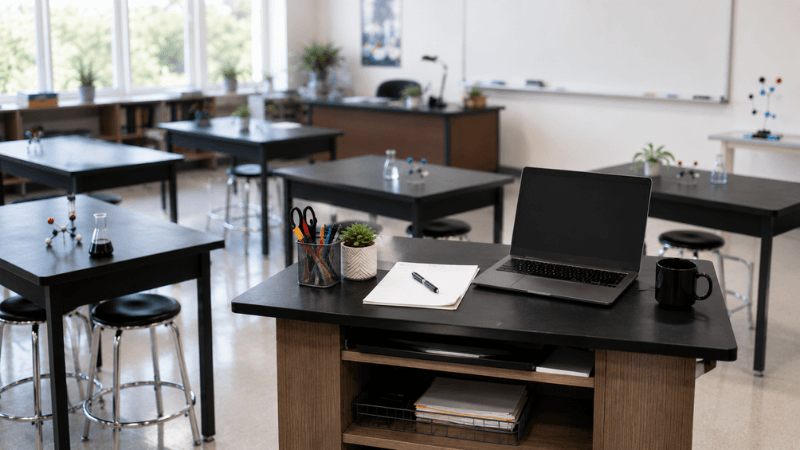
A standing podium desk is one of those science classroom supplies that completely changed the way my room functioned. Instead of keeping my main teacher desk at the front of the room, I like having a small standing desk or podium near the front and moving my larger teacher desk to the back.
This setup gives you a place to teach from, set down your laptop, keep your lesson materials nearby, and quickly glance at your plans without making the front of the room feel like your personal office. It also keeps the main teaching area cleaner and more open, which is helpful when you are modeling on the board, running slides, giving lab directions, or moving between student groups.
I also love that it naturally keeps you more mobile. When your big teacher desk is not the center of the room, you are less likely to get stuck behind it. A podium gives you a landing spot, but it does not take over your classroom. For middle and high school science teachers, that matters because so much of the day involves circulating, checking group work, managing materials, and watching what is happening across the room.
And if you do not want to stand the entire time, add a stool. You still get the benefits of a smaller front teaching station without feeling like you have committed to being on your feet every second of the day. It is a simple classroom setup change, but it can make your science classroom feel more open, organized, and easier to manage.
Plastic Art Trays for Labs and Stations
Plastic art trays are one of those science classroom supplies that make labs and stations so much easier to manage. I like the deeper cafeteria-style trays because they give each group a clear space for their materials without everything spreading across the table.
They are perfect for organizing station supplies, lab materials, task cards, manipulatives, vocabulary sorts, models, measuring tools, or anything students need to carry from one area to another. Instead of handing out ten separate items to each group, you can prep one tray per station or one tray per table and have everything ready to go before class starts.
They also help contain the mess, which is a huge bonus in a middle or high school science classroom. If students are working with small materials, cards, scissors, glue, markers, samples, or lab tools, the tray gives those items a home. At the end of the activity, students can return everything to the tray instead of leaving you with random pieces scattered across six lab tables.
Speaking of labs, have you grabbed your free lab safety contract yet?
Bonus – you can find them at pretty much any dollar store! I would look for ones that are stackable, easy to wipe clean, and deep enough to actually hold materials. They are simple, but they can make lab prep, station rotations, and clean-up feel much more organized.
A Really Good Electric Pencil Sharpener
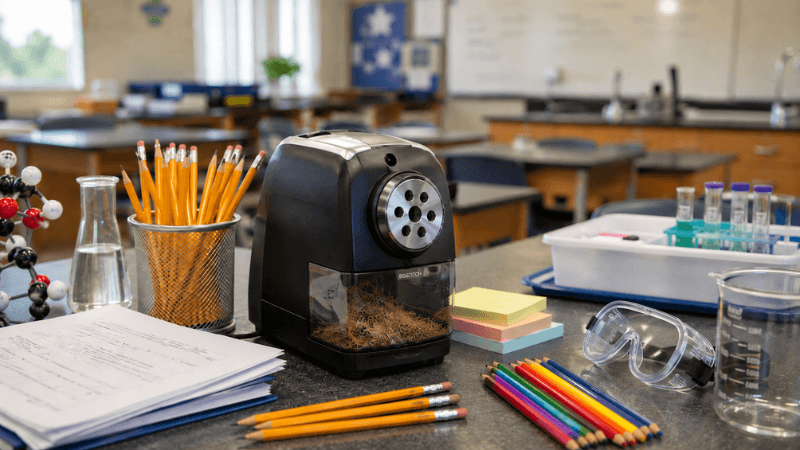
A good electric pencil sharpener may not sound exciting, but in a science classroom, it is absolutely one of those supplies worth being picky about. I am not talking about the tiny sharpener that gives up after three colored pencils and a dream. I mean the best electric pencil sharpener your budget will allow.
Students need pencils constantly. They need them for warm-ups, graphing, labs, data tables, diagrams, labeling models, quick checks, and tests. When the sharpener is slow, loud, jammed, or eating pencils for sport, it becomes one more tiny classroom disruption that happens over and over again.
A strong electric pencil sharpener saves time because students can sharpen quickly and get back to work. It also saves your sanity because you are not stopping class every five minutes to deal with broken points, sad pencils, or the dreaded “it’s not working” announcement from across the room.
This is one of those science teacher supplies where I would rather buy one good one than replace three cheap ones. Look for something sturdy, fast, easy to empty, and powerful enough to handle daily student use. It is not glamorous, but it is a true science classroom must-have if your students use pencils regularly.
If you like implementing coloring in science, it’s so fun to color diagrams, check out this blog for some great secondary science coloring activities.
Poster-Sized Sticky Notes
Poster-sized sticky notes are definitely one of the more expensive science classroom supplies on this list, but they are also one of the most useful. They are basically giant sticky notes that students can write on during group work and then stick directly to the wall, whiteboard, cabinets, or wherever you have space.
I love using them when I want student groups to create something that can be shared quickly with the class. They work well for lab conclusions, CER responses, data analysis, model building, vocabulary connections, station summaries, review posters, and group brainstorming. Instead of having every group keep their work flat on a table, you can instantly turn the room into a gallery walk.
The best part is that they make student thinking visible. Once the posters are up, students can compare ideas, look for patterns, leave feedback, or explain their reasoning to another group. This is especially helpful in a middle or high school science classroom because students often need to talk through complex ideas before they can write about them clearly.
They are not the cheapest classroom supply, so I would save them for the activities where you really want student work displayed, discussed, or moved around the room. For everyday group work, large whiteboards may be more budget-friendly. But when you want a quick, no-tape-needed way to get student ideas up on the walls, poster-sized sticky notes are absolutely a science classroom must-have.
Before You Buy Every Classroom Supply
The best science classroom supplies are the ones that make your day feel a little less chaotic. They do not have to be fancy. They just need to solve real problems, like messy papers, noisy transitions, group work chaos, or students calling your name from every corner of the room.
Start with the one thing that would make your classroom life easier right now. Maybe that is a timer, a drawer organizer, a good pencil sharpener, or a set of group whiteboards. You do not need a perfect classroom. You just need a few simple systems that help you teach without feeling like you are constantly putting out tiny fires.
You may like …
-
Free Biology Curriculum Map and Pacing Guide
$0.00 -
Qualitative and Quantitative Observations Lab
$3.99 -
Theory vs Law Reading Comprehension
$4.99 -
Amoeba Sisters Video Handouts Growing Bundle
Original price was: $232.52.$157.52Current price is: $157.52.