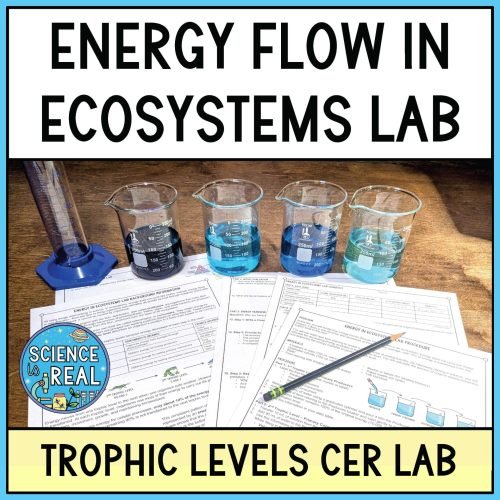
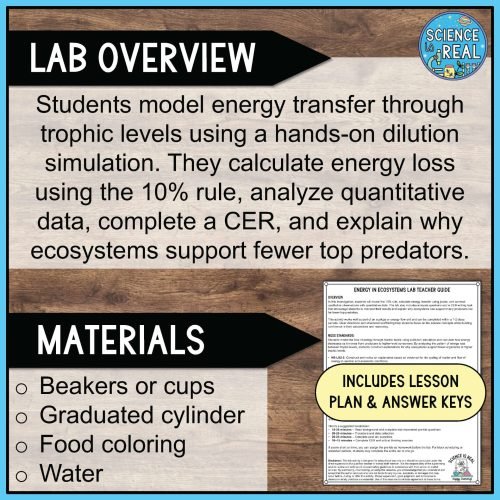
Bring trophic levels and energy pyramids to life with this hands-on Energy in Ecosystems Lab Activity! Students model how energy moves through trophic levels using a simple dilution investigation that clearly demonstrates the 10% rule and why energy decreases at each step of an energy pyramid.
Perfect for making an abstract concept visual, interactive, and unforgettable!
Armed with just water, food coloring, graduated cylinders, and beakers, students simulate how energy is transferred through an ecosystem while completing calculations, analyzing quantitative data, and completing a CER activity.
This trophic levels lab helps students see how energy drops dramatically from producers to top predators.
By the end of this ecology lab, students will have modeled an energy pyramid, calculated energy transfer using joules, and explained why ecosystems can support many producers but far fewer top predators.
This Energy in Ecosystems Lab Activity includes:
- Teacher Guide: A detailed teacher overview with pacing suggestions, NGSS alignment, materials list, and guidance for running the lab smoothly. (1 page)
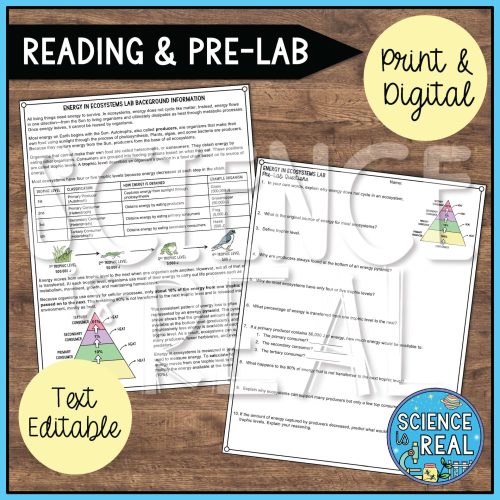
- Background Reading & Pre-Lab Questions: A concise student-friendly overview of energy flow in ecosystems, trophic levels, and the 10% rule, followed by text-dependent questions to build understanding before the investigation. (2 pages)
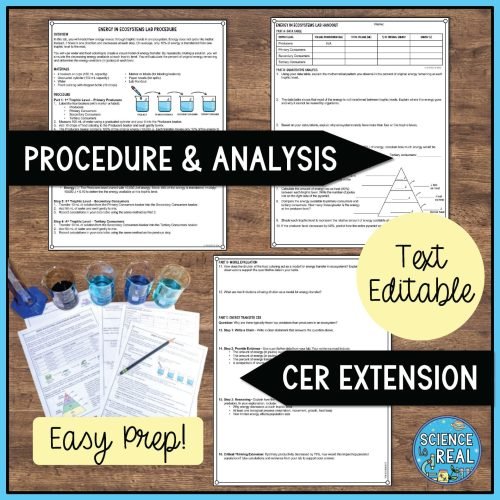
- Student Lab Handout: A structured investigation where students model energy transfer using a dilution simulation, complete a data table, calculate energy transfer in joules, and analyze patterns in an energy pyramid. (1 page)
- Data Analysis & Modeling: Students complete quantitative analysis questions, calculate energy loss between trophic levels, and build their own energy pyramid model using real data from the lab. (1 page)
- Critical Thinking & CER: Higher-level analysis questions, model evaluation prompts, and a CER writing task that asks students to explain why ecosystems support fewer top predators than producers. (1 page)
Editable (PPT), printable (PDF), and digital (Google Slides) versions are all included!
Materials are simple—just water, three beakers (or clear cups), a graduated cylinder, and 10 drops of food coloring are needed per group! This lab fits neatly into a single 45–60 minute period and works perfectly as part of your ecology unit.
Why teachers love this Energy in Ecosystems Lab:
- Simple setup: Just water, food coloring, beakers, and a graduated cylinder make this ecology lab easy to prep and run.
- Highly visual learning: The dilution model clearly shows how energy decreases at each trophic level, helping students understand energy flow in ecosystems.
- Built-in math integration: Students calculate energy transfer using the 10% rule, analyze data in a trophic levels lab data table, and apply proportional reasoning.
- Higher-level thinking included: Students evaluate the lab model and write a CER explanation about why ecosystems support fewer top predators than producers.
- Strong NGSS alignment: Supports HS-LS2 standards related to energy flow in ecosystems and trophic interactions.
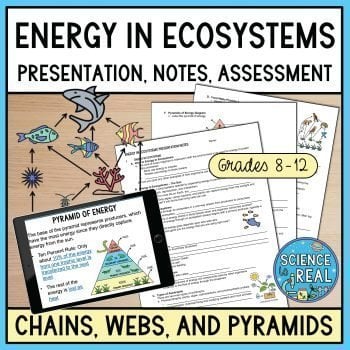
MORE ENERGY IN ECOSYSTEMS ACTIVITIES
PURCHASE ON TPT