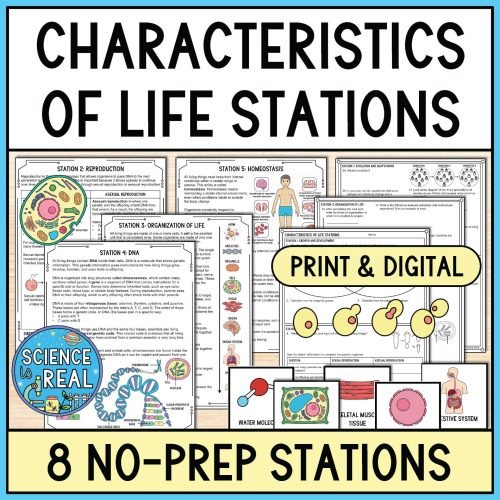
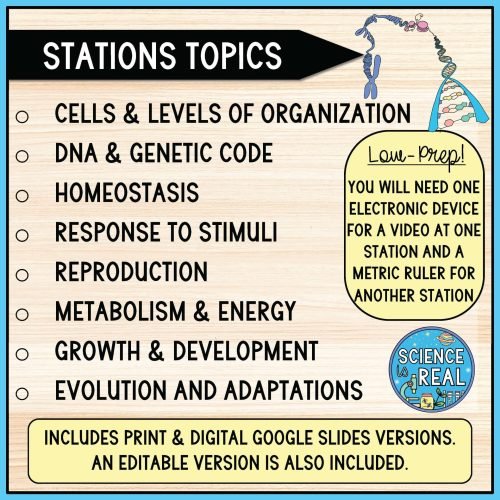
These characteristics of life stations focus on the major traits all living things share, including growth and development, reproduction, cells and organization, DNA, homeostasis, metabolism, evolution, and response to stimuli.
Students explore each characteristic through short readings, hands-on activities, card sorts, diagram analysis, sequencing tasks, and reasoning-based questions.This characteristics of life stations lab activity is a fun way to get students moving, collaborating, and learning in a variety of meaningful ways while reinforcing key biology concepts.
Perfect as a standalone biology lesson or as part of my growing Biology Lab Stations Bundle – on sale now!
Characteristics of Life Stations Overview
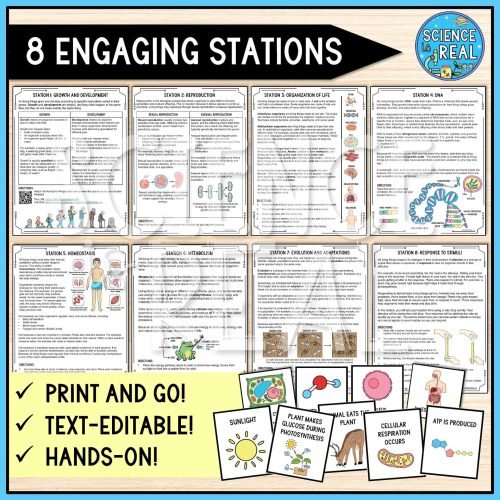
- Station 1: Growth and Development: Students compare growth and development as related but different characteristics of life. They complete a Venn diagram and analyze how organisms increase in size, gain mass, mature, and change through life stages.
- Station 2: Reproduction: Students read about sexual and asexual reproduction and compare the two types using a graphic organizer. They identify differences in parents involved, genetic variation, speed, and examples of organisms that reproduce each way.
- Station 3: Organization of Life and Cells: Students explore how living things are made of one or more cells and how multicellular organisms are organized into levels. They complete a hands-on card sort by placing biological levels in order from smallest to largest and matching each level with its definition and example.
- Station 4: DNA and Heredity: Students learn how all living things contain DNA and how DNA stores genetic information. They read about genes, chromosomes, nitrogenous bases, and the universal genetic code, then label a DNA diagram to reinforce important structures.
- Station 5: Homeostasis: Students read about how living things maintain stable internal conditions. They complete a card sort by matching each imbalance with the correct body response and result, helping them understand how organisms regulate conditions such as body temperature, water levels, blood sugar, and carbon dioxide.
- Station 6: Metabolism: Students explore how living things obtain and use energy. They complete an energy pathway sequencing activity to show how energy moves from sunlight or food into a usable form for cells through photosynthesis, food molecules, cellular respiration, and ATP.
- Station 7: Evolution and Adaptations: Students learn that individual organisms do not evolve, but populations can change over many generations. They complete a card sort to distinguish individual changes from population changes and analyze how adaptations can become more common over time.
- Station 8: Response to Stimuli: Students investigate how living things respond to changes in their environment. They complete a hands-on ruler drop activity to test reaction time, then identify the stimulus and response involved in the activity.
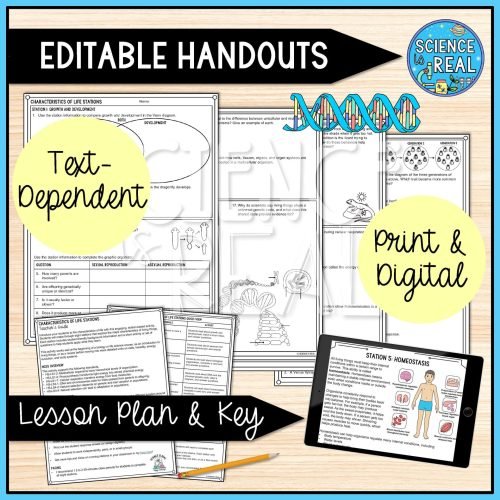
These characteristics of life stations include printable station cards, student handouts, answer keys, card sort materials, a Google Slides version, and a text-editable version for teacher customization.
Easy to Find Materials & Low Prep
- All you need is one electronic device for one station (to view a short video) and a metric ruler for another station. That’s it!
- With the included teacher’s guide and lesson plan, you will receive a characteristics of life stations overview page with each station’s overview and necessary materials needed to be placed at each station. You do not need station signage because each station card is clearly marked with the station number and name.
Perfect for engaging students at the beginning or end of your characteristics of life unit, as a formative check within a unit, or as an in-depth review! Your download includes eight editable stations, editable student handouts, a helpful teacher’s guide, answer key, and a link to the Google Slides version of the activity.
Your Characteristics of Life Stations Download Includes:
- Stations Cards (text-editable PPT and PDF)
- Student Answer Sheet (text-editable PPT and PDF)
- Teacher’s Guide and Lesson Plan
- Original Content, Diagrams, Card Sorts, and Activities
- Answer Key
- Google Slides Version of the Activity
*This activity is designed to take about 2 50-minute class periods. It is editable to meet your needs and time constraints.
MORE LAB STATIONS
CHARACTERISTICS OF LIFE ACTIVITIES
PURCHASE ON TPT