
If you’re looking for fun, low-stress holiday science activities that still pack real content, you’re in the right place. December can feel chaotic, but it doesn’t have to mean “throwaway” lessons. With the right mix of hands-on projects, simple materials, and clear learning targets, you can keep middle and high schoolers engaged while still hitting standards.
Below, you’ll find a collection of classroom-tested holiday science activities that work beautifully in grades 6–12. You can run them as full labs, quick stations, or “just before break” lessons that don’t turn into crowd control. Many of them double as keepsakes students can take home, which is always a win in December.
Happy Holidays from me to you! I’ve included two free holiday science activities to help make your December planning a little lighter.
Parachuting Santa STEM Challenge: Gravity and Drag

In a parachuting Santa STEM challenge, students design a parachute to help “Santa” (a small figurine or cardstock cutout) land safely. Activities like this naturally lead into discussions of:
- Gravity as the force pulling Santa toward Earth
- Air resistance (drag) as the force opposing motion
- How surface area and parachute shape affect fall time
Have students:
- Test different parachute materials (tissue paper, plastic, coffee filters)
- Measure drop times from a set height
- Graph results and write a short conclusion
This is a highly engaging December engineering design task and fits nicely in a Christmas science lab line-up focused on forces and motion.
Winter Holiday Science Stations

If you’re looking for holiday science activities that keep middle and high school students focused, festive, and genuinely excited to learn, these Winter Holiday Science Stations are a game-changer. Each of the six stations blends hands-on exploration with seasonal themes, giving you rigorous Christmas science activities without the prep or chaos.
Students investigate real vs. artificial holiday trees, model snowflake symmetry, test holiday-themed diffusion with scented baggies, explore polar bear insulation in icy water, graph daylight changes around the winter solstice, and identify symbiotic relationships in holiday scenarios. Every station is quick, meaningful, and designed to make December teaching easier.
Most materials are simple—copy paper, scissors, cotton balls, scents, baggies, shortening, and icy water—making setup stress-free during the busiest time of year. These stations are perfect for classwork, a festive lab day, or an engaging end-of-semester activity that still reinforces essential science skills.
Want to see everything inside? You can get a closer look in my detailed blog post dedicated entirely to these Winter Holiday Science Stations.
Marshmallow Tower Holiday STEM Challenge
Marshmallow towers are perfect when your students are wiggly and chatty. Give them:
- Mini marshmallows or gumdrops
- Toothpicks or spaghetti
- A simple design challenge: build the tallest or strongest “winter tower”
You can connect this activity to center of mass, structural stability, and the strength of geometric shapes like triangles versus squares. It even parallels real-world engineering problems such as building skyscrapers or bridges.
To push it beyond a party game, add requirements and reflection:
- Minimum height or weight-bearing requirement
- Limited materials to mimic engineering constraints
- Short written explanation of why certain designs were more stable

Borax Christmas Ornaments: Supersaturated Solutions in Action

Borax ornaments are a perfect blend of holiday fun and real chemistry. With just borax, hot water, pipe cleaners, yarn, and a jar or styrofoam cup, students create their own sparkling ornaments while seeing solubility, saturation, and crystal formation happen right in front of them.
Students shape pipe cleaners into snowflakes, stars, or initials, then hang them in a hot borax solution. As the solution cools, it becomes supersaturated and begins depositing crystals onto the pipe cleaner surface. By the next day, they have a glittering ornament to take home and a concrete understanding of solute, solvent, and how heating increases solubility. You can learn more the full how-to and the science behind borax ornaments here.
This quick, low-prep activity makes an excellent Christmas science lab, reinforcing key chemistry concepts while giving students a keepsake they’ll be excited to show off.
Free Ugly Sweater Christmas Science Activity

If you want holiday science activities that are fun and academically meaningful, the Ugly Christmas Sweater Science Project is perfect for December. This activity mixes science literacy with creativity, giving students a festive task that still reinforces real content.
Students start with a reading that explains the science behind ugly sweaters. Afterward, they answer quick comprehension questions to keep the focus on science skills.
Then comes the creative part. Students design their own ugly sweater using one of two options:
- A sweater based on a real scientist
- A sweater built around a science topic you’re teaching (cells, genetics, ecology, astronomy, etc.)
They’ll have templates, guiding questions, and a rubric to keep the project structured and meaningful.
This activity fits perfectly into your holiday science activities because it’s fun, rigorous, and easy to run—great for classwork, sub days, or the week before winter break.
Want it free? You can download the entire project by signing up below.
Gingerbread Playdough: Sensory Learning Meets Simple Chemistry
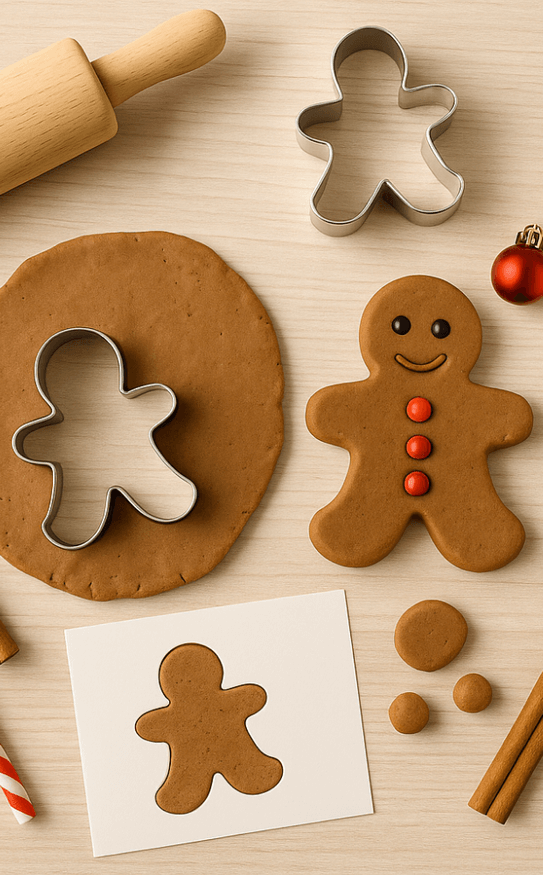
Gingerbread playdough is an excellent way to bring real chemistry into your holiday science activities without the mess of a full lab. A standard batch uses 2 cups flour, 1 cup salt, 2 tablespoons cream of tartar, 2 tablespoons oil, 1½ cups water, and warm spices like ginger and cinnamon. When the mixture is heated, students can observe the chemistry of mixtures and texture change happen in real time.
As the dough warms, the starch molecules in flour absorb water and swell, thickening the mixture. Salt strengthens the network structure, making the dough firmer, while cream of tartar stabilizes the starch gel, helping it stay smooth instead of turning gritty. Oil coats particles and reduces friction, giving the dough its soft, stretchy feel.
These changes make the playdough a perfect model for discussing:
- Properties of mixtures and solutions
- How heat affects solubility and molecular movement
- Intermolecular forces at work in everyday materials
- Why varying water or flour ratios shifts the dough from stretchy to crumbly
For older students, it’s a simple entry point into particle models and the chemistry of polymers. Whether you run it as a station or a mini-lab, gingerbread playdough turns a familiar classroom favorite into a clear, hands-on investigation of how ingredients interact at the molecular level.
Science of Snowflakes Webquest – Perfect Snow Day Activity
This Science of Snowflakes Webquest is a no-prep, seasonal activity where students explore how snowflakes form, why they have six sides, and why no two are the same. It works beautifully as an introduction, sub plan, guided practice, independent extension, or even a snow day science assignment.
Students will:
- Watch real snowflake time-lapses
- Read about how snowflakes grow
- View a short fun Ted Ed video
- Simulate snowflake formation under different temperatures and humidity levels
- Explore why snowflakes have six sides and unique patterns
- Complete an optional paper snowflake extension
A quick, engaging way to bring meaningful winter science into your classroom.
Snowflake STEAM Activity: Symmetry, Structure, and Design
A snowflake STEAM build is a beautiful way to blend art, science, and creativity in December. This activity turns your classroom into a mini design studio as students explore symmetry, molecular structure, and the conditions that shape real snowflakes. It’s simple to prep, highly visual, and perfect for adding hands-on learning to your holiday science activities.

Students start by sketching or folding and cutting their own paper snowflakes, then compare their designs to photographs of real snow crystals. This opens the door to a meaningful discussion about why snowflakes form with six-sided symmetry—a direct result of water molecules arranging themselves into repeating hexagonal patterns during crystallization.
Ways to Level It Up for Grades 6–12:
- Have students classify different snowflake shapes (stellar, plate, dendrite, column) and connect each type to temperature and humidity conditions.
- Integrate art and math by requiring radial symmetry, repeated motifs, or consistent angles, turning it into a true cross-curricular STEAM task.
- Challenge students to redesign their snowflakes after learning how molecular structure determines shape, reinforcing how science informs design.
This snowflake activity pairs perfectly with other holiday science activities on water, weather, or phase changes, and it brings just the right amount of seasonal magic to your winter lessons.
Holiday Science Color-By-Numbers
One of my most simplest holiday science activities is my Science Holiday Coloring Page Freebie, and it’s back again. This festive download gives students a fun way to review science concepts and complete a cute holiday-themed color-by-number page—perfect for warm-ups, early finishers, or the last days before break.
The freebie includes:
- A set of biology review questions covering key concepts
- A holiday color-by-number sheet that reveals a seasonal image as students answer correctly
- An editable version so teachers can customize the questions for any unit, topic, or level
- A simple format that works in any biology class, from intro to honors
It’s quick, low-prep, and adds just the right amount of seasonal fun without losing instructional value. Students stay engaged, you reinforce essential content, and your lesson plans stay stress-free.
Yes, There’s More Holiday Science Activities!
Chemistry Holiday Science Activities
1. Candy Cane Chemistry (Dissolving Lab)
Compare how candy canes dissolve in hot vs. cold water, vinegar, or oil. Great for solubility and intermolecular forces.
2. Hot Cocoa Heat Transfer Lab
Students test conduction, convection, and radiation by measuring how quickly hot cocoa cools in different cup materials.
3. Christmas Light Circuit Challenge
Use mini holiday lights to build series and parallel circuits, test conductivity, or design a light-up holiday card.
4. Chromatography Ornaments
Students draw on coffee filters with markers, run chromatography with water, and turn the separated pigments into ornaments.
5. Gingerbread Cookie Chemical Reactions
Analyze physical vs. chemical changes in cookie baking (expansion, browning, Maillard reaction).
Biology Holiday Science Activities
1. Poinsettia pH Lab
Use poinsettia extract as a natural pH indicator to test acids and bases.
2. Reindeer Adaptations Mini-Lesson
Explore Arctic adaptations: hollow fur, specialized hooves, UV-sight, and seasonal behavior.
3. Holiday Seed Dispersal Challenge
“Help the elves deliver seeds!” Students design seed models that travel via wind, bounce, or float.
4. Peppermint Enzyme Lab
Test how temperature affects catalase activity using mint candies and hydrogen peroxide (safe, visual, fast).
5. Evergreen Leaf Stomata Stamping
Examine stomata density on pine or holly leaves; discuss photosynthesis in winter conditions.
Earth and Environmental Science Holiday Activities
1. Winter Weather Fronts Simulation
Use colored water and ice to model cold fronts, warm fronts, and density-driven movement.
2. Climate + Holiday Lights Energy Audit
Students calculate energy use of LED vs. incandescent holiday lights and determine carbon footprint differences.
3. Snowpack and Albedo Lab
Compare how different surfaces reflect or absorb light using aluminum foil, white paper, or soil under a lamp.
4. Make-Your-Own “Frost” with Sublimation
Use dry ice to model deposition and frost formation (with safety protocols).
5. Melting Ice Ornament Challenge
Shape ice ornaments and test melting rates on different surfaces or under different light intensities.
Physics and STEM Holiday Science Activities
1. Jingle Bell Sound Wave Demo
Compare sound frequencies using different sizes of bells; discuss amplitude and vibration.
2. Elf Zipline Engineering
Students design the fastest or slowest zipline for a small elf figurine using string and basic materials.
3. Sleigh Speed Challenge
Create model sleighs and test how surface texture affects friction and speed.
4. Holiday Catapult (Marshmallow Launcher)
Build small catapults to launch mini marshmallows; graph distance vs. angle.
5. Holiday Structures Strength Test
Construct gingerbread-style structures with graham crackers and icing, then test strength under different loads.
You’re doing incredible work—especially in the busiest month of the year. I hope these holiday science activities help keep your lessons fun and meaningful. Happy Holidays and Happy Sciencing!

Check Out More Holiday Science Activities!
-

Winter Holiday Science Stations
$5.99 -

Science of Snowflakes Webquest – Fun Snow Day Activity!
$5.99 -

Science of Love Reading Comprehension – Valentine’s Day Science
$4.99 -
Halloween Science Reading Comprehension and Worksheets
Original price was: $4.99.$3.99Current price is: $3.99.


