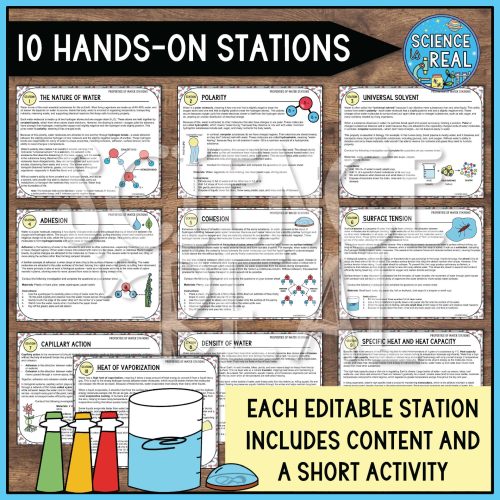
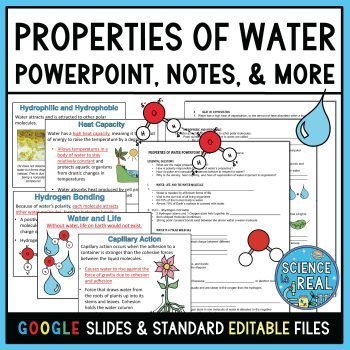
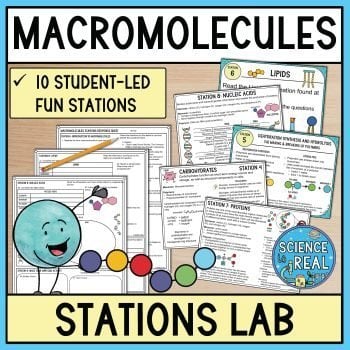
This properties of water stations lab is a great way to get your kids moving and interacting hands-on with content in a variety of fun and engaging ways! Students will explore all of water’s amazing properties in these ten low-prep properties of water stations that use materials already found in most classrooms!
This properties of water stations lab is unique because all stations include necessary background information with important content, definitions, examples, and more! This makes for a great no-prior-knowledge needed activity! Perfect for engaging students before diving deep into a unit or for review!
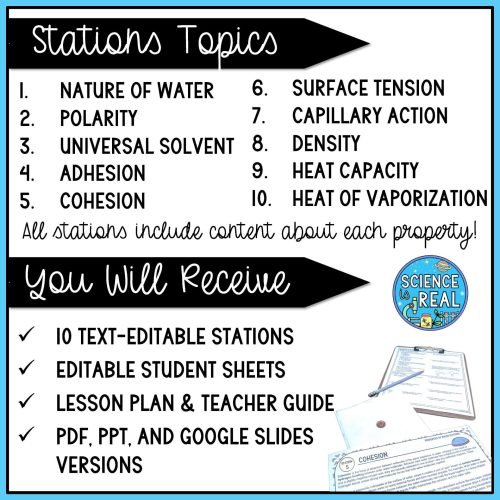
Your download includes ten text-editable stations, editable student handouts, a 3-page teacher’s guide and lesson plan, and Google Slides version of the activity.
Properties of Water Stations Overview:
Station 1: Nature of Water
Students read about hydrogen bonding, nature of water (solutions, solvent, solute), and an overview of polarity. They then answer questions and label and color water molecules.
Station 2: Polarity
Students read about polarity, polar and nonpolar substances, hydrophobic and hydrophilic substances, and complete an investigation with water, food coloring, and oil. They then answer questions to round out the activity on their answer sheets.
Station 3: Universal Solvent
Students read about how water is often called a universal solvent and how water dissolves substances. They then complete an investigation with salt, sugar, and water and answer corresponding questions.
Station 4: Adhesion
Students learn about adhesion and examples of adhesion in nature. They then complete an investigation using a plastic or foam plate, a drop of water, and a paper towel. Students answer questions corresponding to these activities on their answer sheet.
Station 5: Cohesion
Students read about cohesion and examples of cohesion in nature. They then complete the classic drops of water on a penny lab and complete the corresponding questions on their answer sheet.
Station 6: Surface Tension
Students explore surface tension and examples of surface tension in nature. They investigate this property by floating a paperclip on top of a bowl of water and then break the surface tension of the water with a drop of dish soap. They then answer corresponding questions to this station.
Station 7: Capillary Action
Students investigate capillary action by reading about this phenomenon and observe capillary action in action using a paper towel, food coloring, an empty cup, and a cup half full of water. They then answer the station’s questions on their editable answer sheet.
Station 8: Density
Students read about the density of water and its properties that make it possible for solid ice to float on liquid water. They then complete a simple demonstration using ice and water and answer corresponding questions.
Station 9: Heat Capacity and Specific Heat
Students read about water’s specific heat, heat capacity, and the significance of this property in nature and in maintaining homeostasis. They then will complete a feel-test to test which substance, sand or water, is most affected by rising temperatures.
Station 10: Heat of Vaporization
Students will read about the heat of vaporization and evaporative cooling and complete their own investigation to experience themselves evaporative cooling using a cotton ball dabbed with water versus a cotton ball dabbed with rubbing alcohol. As with all stations, they will answer corresponding questions on their answer sheet.
Easy Set Up:
- With the included lesson plan and teacher’s guide, you will receive a stations overview page with each station’s overview and necessary materials needed to be placed at each station. You do not need station signage because each station card is clearly marked with the station number and name.
Easy to Find Materials:
- This lab is designed to use materials you already have in your classroom or at the dollar store. Stations are editable, so feel free to omit any that you do not have materials for or demonstrate stations as a whole class to reduce the amount of materials needed. You will need water, vegetable oil, food coloring, salt, pepper, sugar, small clear plastic cups, a pie plate or shallow small container of sand, a pie plate of shallow small container of water, dish soap, cotton balls, plastic or foam tray, droppers or pipettes, a penny, paperclip, paper towels, a toothpick or fork (to help lower the paperclip into the water), rubbing alcohol, ice cubes, a plastic or foam plate, and some stirring devices (spoons work just fine).
Properties of Water Stations Download Includes:
- Ten Properties of Water Stations Cards (PDF and Google Slides)
- 4-Page Student Answer Sheet (PDF and Google Slides)
- 3-Page Teacher’s Guide and Lesson Plan (PDF)
- Original Content, Diagrams, and Activities
- Answer Key (PDF)
- Editable Stations Cards and Handout (Text-editable PPT)
MORE PROPERTIES OF WATER ACTIVITIES
LAB STATIONS
PURCHASE ON TPT