

Description
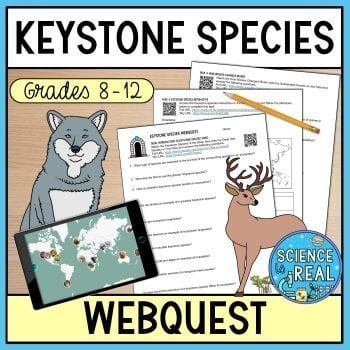
This keystone species video handout accompanies an engaging and dynamic documentary about the interconnection between keystone species, trophic levels, and ecosystems. It includes questions (in sequence) to accompany HHMI Biointeractive’s 20 minute documentary titled Some Animals Are More Equal than Others: Keystone Species and Trophic Cascades.
This handout is perfect for an introduction or enrichment to the keystone species and ecosystems, a great sub-plan, enrichment, or lesson all in its own right. It’s perfect for Biology, Ecology, and Environmental Science classes.
The 20-question keystone species video handout handout include a prior-knowledge hook question, 15 short answer questions that are timed in sequence to the video, and 5 summarizing analysis questions (including a CER style question!). The questions are formatted short-answer style, however no answer is much longer than 1-3 words. The questions are spaced out so that they do not go too fast or too slow and encompass the entire film from start to finish.
⭐ KEYSTONE SPECIES VIDEO HANDOUT TOPICS ⭐
- Keystone Species
- Biodiversity
- Trophic Levels
- Trophic Cascades
- Ecosystems
- Populations and Communities
- Predator and Prey Relationships
- Food Webs and Food Chains
- Human Impact
- Biodiversity
The video is free and found on the hhmi Biointeractive’s website HERE or on YouTube HERE
⭐ KEYSTONE SPECIES VIDEO HANDOUT INCLUDES ⭐
- 2 Page PDF Version with link and QR code
- Google Slides Version with Pre-formatted Text Boxes and Video Link
- Answer Key (timestamped)
Video Description from HHMI Biointeractive –
“Keystone species and trophic cascades are fundamental concepts in ecology. This short film tells the story of how these concepts were first established through the pioneering experiments of two young researches: Robert Paine and James Estes. The short film opens with two questions: “What determines how many species live in a given place? Or how many individuals of the species can live somewhere?” The research that provided answers to these questions was set in motion by key experiments by ecologists Robert Paine and James Estes. Robert Paine’s starfish exclusion experiments on the coast of Washington state showed that removing starfish from this marine ecosystem has a big impact on the population sizes of other species, establishing the starfish as a keystone species. James Estes and colleague John Palmisano discovered that the kelp forest ecosystems of the North Pacific are regulated by the presence or absence of sea otters, which feed on sea urchins that consume kelp. These direct and indirect effects of sea otters on other species describe a trophic cascade. These early studies were the inspiration for hundreds of investigations on other keystone species and trophic cascades, as well as ongoing studies into the regulation of population sizes and species numbers.”
Film Awards
- 2016 Jackson Hole Science Media Awards: Finalist
⭐ MORE GREAT ECOLOGY ACTIVITIES
⭐ PURCHASE ON TPT
HAPPY SCIENCING!


Reviews
There are no reviews yet.