These twelve enzymes stations are text-dependent, so students learn about enzymes as they go! This enzymes activity is a great way to get your kids moving and interacting hands-on with enzymes in a variety of fun and engaging ways!
$8.99

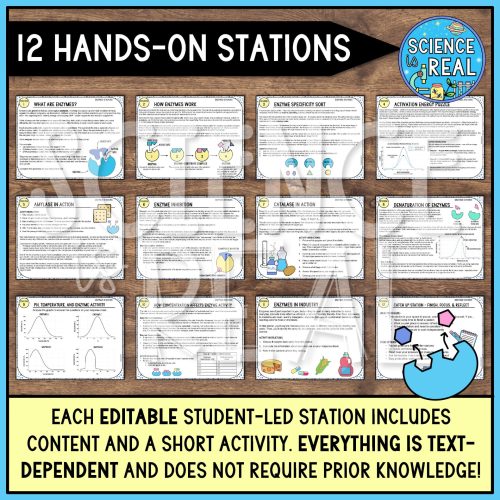
These twelve enzymes stations are text-dependent, so students learn about enzymes as they go! This enzymes activity is a great way to get your kids moving and interacting hands-on with enzymes in a variety of fun and engaging ways!
Students will explore the structure, function, and behavior of enzymes in these twelve low-prep enzyme stations that use materials commonly found in most science classrooms!
This enzymes stations lab is unique because all stations include necessary background information with important content, definitions, examples, and more! This makes for a great no-prior-knowledge needed activity! Perfect for engaging students before diving deep into a unit or for review!
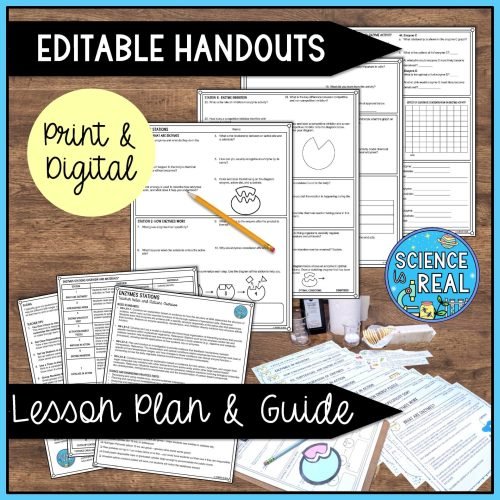
Your download includes ten text-editable stations, editable student handouts, a 3-page teacher’s guide and lesson plan, and Google Slides version of the activity.
This fun activity is included in a discount lab stations bundle!
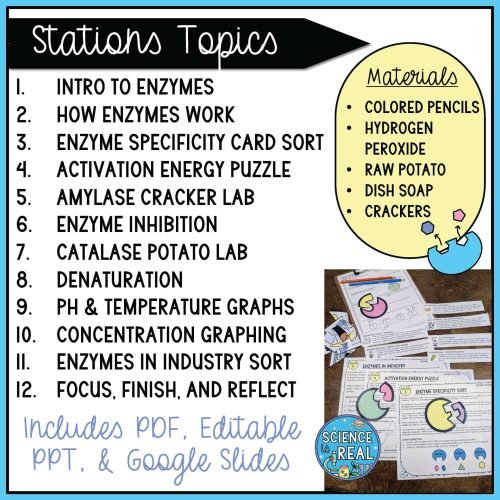
Station 1: What are Enzymes?
Students read about the basics of enzymes and complete activities on their response sheet, including coloring and labeling parts of an enzyme.
Station 2: How Enzymes Work
Students read and analyze a diagram about enzymes in action. They then answer questions and label and annotate an enzymes diagram on their response sheet.
Station 3: Enzyme Specificity Matching Sort
Students read enzyme specificity, the lock and key model, and the induced fit model. They will use provided paper models to match enzymes with their corresponding substrates and answer question on their response sheet.
Station 4: Activation Energy Puzzle
Students will read about activation energy and analyze a graph showing reaction progress with and without an enzyme. They will then race to assemble the provided blank puzzle and a puzzle with an image to model how activation energy reduces the time and effort it takes to complete a chemical reaction with and without enzymes.
Station 5: Amylase Cracker Lab
Students read about how amylase in saliva catalyzes chemical reactions and slowly chew a cracker to experience how the taste gets sweeter as amylase does its work. They will then answer questions to this activity on their response sheet.
Station 6: Enzyme Inhibition
Students explore the role of enzyme inhibitors and read about competitive and non-competitive inhibition. They will then answer questions and draw these types of inhibitors on an enzyme.
Station 7: Catalase Potato Lab
Students will see first-hand how enzymes catalyze chemical reactions by observing the bubbles created when a chunk of raw potato is rested in a small amount of hydrogen peroxide. They answer analysis questions on their response sheet.
Station 8: Denaturation of Enzymes
Students read about the causes and effects denaturation, optimal pH and temperature, and analyze a graph showing these processes. They will then complete activities on their response sheet – including creating a model of a denatured enzyme.
Station 9: pH, Temperature, and Enzymes Activity
Students will analyze four graphs and answer corresponding questions about optimal temperatures, optimal pHs, and denaturation shown on the graphs.
Station 10: Enzyme and Substrate Concentration with Saturation
Students will read how substrate concentration and enzyme concentration play a role in enzyme activity. They will then use a simple data set to construct a graph showing how enzyme activity is affected by the concentration of substrates.
Station 11: Enzymes in Industry Task Cards
Students will choose six task (from ten choices) and read about various enzymes used in industry and biotechnology. They will summarize their findings on their student response sheet.
Station 12: Catch Up Station – Finish, Focus, and Reflect
This station provides an area for students to finish up questions, focus quietly, or get more help from their peers or instructor. I find that having this type of station allows you to identify the students who may need more help and provides a single area for students to work quietly without bothering other stations.
This enzymes lab is designed to use materials you already have in your classroom or at the dollar store. These enzymes stations are editable, so feel free to omit any that you do not have materials for or demonstrate stations as a whole class to reduce the amount of materials needed.
You will need: