Teaching ecology has never been easier. This complete 40-day ecology unit gives you daily lesson plans, warm-ups, labs, stations, webquests, reading comprehensions, graphic organizers, presentations, quizzes, review games, a project, and assessments already sequenced and ready to go.
Your students will explore how ecosystems function, interact, change, and respond to natural and human-caused disturbances through engaging lessons, hands-on labs, real-world investigations, and meaningful activities that bring ecology concepts to life. You’ll save hours of prep time with ready-to-use activities.
Each resource is standards-aligned and organized by the day, so you’ll always know exactly what to teach and when. Daily editable lesson plans are included for every day of the unit, making it easy to walk in and teach with confidence. This ecology unit is part of my full-year biology curriculum bundle.
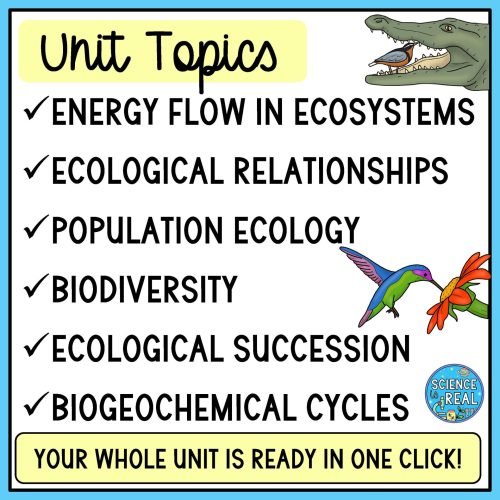
Topics Covered in This Ecology Unit:
Energy Flow in Ecosystems
- Intro to ecology, biotic and abiotic factors, and levels of organization
- Food chains, food webs, trophic levels, and ecological pyramids
- Producers, consumers, decomposers, detritivores, and the 10% rule
- Photosynthesis and chemosynthesis
Biogeochemical Cycles
- Matter cycling through ecosystems
- Water, carbon, nitrogen, and phosphorus cycles
- Reservoirs, Earth’s spheres, photosynthesis, and cellular respiration
- Human impacts on biogeochemical cycles
Ecological Relationships
- Symbiosis, mutualism, commensalism, and parasitism
- Competition, predator-prey relationships, and herbivory
- How species interactions affect ecosystem stability
Population Ecology
- Population density, geographic range, distribution, and age structure
- Population change, immigration, emigration, births, and deaths
- Exponential and logistic growth, carrying capacity, and limiting factors
- Invasive species and predator-prey graphs
Biodiversity
- Genetic, species, and ecosystem diversity
- Species richness, species evenness, and biodiversity index
- Keystone species, invasive species, and bottleneck events
- Ecosystem stability, ecosystem services, hotspots, and conservation
Ecological Succession
- Disturbances, succession stages, and pioneer species
- Primary, secondary, and aquatic succession
- Climax communities and biodiversity changes over time
- Fire, human impact, and ecosystem recovery
Human Impact and Ecology Connections
- Biomagnification and toxin movement through food chains
- Population growth, resource use, deforestation, and land-use change
- Climate change, carbon footprints, and ecosystem disturbances
- Ecosystem recovery and evidence-based solutions
Ecology Unit Includes:
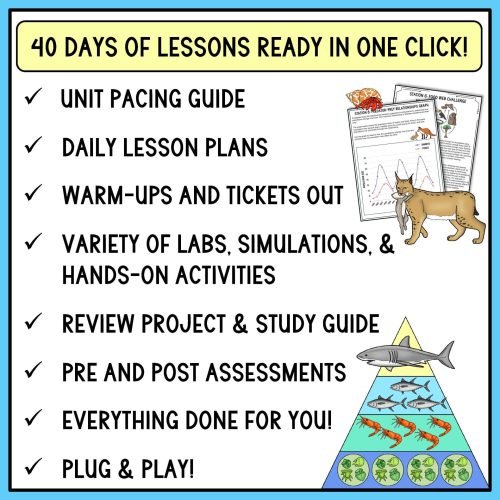
- Unit Plan and Pacing Guide: This ecology unit pacing guide gives you a complete overview of the unit with standards, pacing, topics, and structure. It is perfect for quick reference and pairs seamlessly with the daily lesson plans. Teach with confidence knowing exactly what to cover each day with a clear roadmap from start to finish. Get a free sample of the unit plan and pacing guide here.
- Daily Lesson Plans: Each day includes a comprehensive daily lesson plan with your objective, overview, agenda, materials, teacher directions, ticket out the door, teacher tips, and differentiation strategies. These daily plans are designed to help you move through the unit smoothly while keeping everything organized and easy to follow.
- Engaging Daily Warm-Ups: Every lesson starts with a short warm-up designed to spark curiosity, review previous learning, or help students make connections to real-world ecology concepts. Speaker notes include sample student answers, discussion prompts, and extension ideas to support meaningful classroom conversations.
- Hands-On Labs and Activities: Students explore ecology through hands-on investigations, including an energy flow lab, biodiversity lab, population ecology stations, ecological relationships gallery walk, energy in ecosystems stations, and biomagnification lab. These activities help students model energy transfer, analyze biodiversity and ecosystem stability, and investigate how toxins move through food chains.
- Presentation and Notes: Ready-to-use editable presentations and student notes are included for major ecology topics, including energy flow, biogeochemical cycles, ecological relationships, population ecology, biodiversity, and ecological succession. These lessons are designed to support direct instruction while keeping students actively engaged.
- Meaningful and Engaging Activities: Stations, webquests, video handouts, reading comprehension activities, graphic organizers, booklet activities, and Careers in Science pages help students interact with ecology concepts in a variety of ways. These activities are great for supporting different learning styles while keeping the unit organized and purposeful.
- Ecology Poster Project: Students bring the entire unit together with a culminating ecology poster project. They analyze a real-world ecosystem disturbance and explain impacts on energy flow, populations, biodiversity, biogeochemical cycles, succession, recovery, and evidence-based solutions.
- Unit Review, Study Guide, and Assessments: This unit includes pre-tests, quizzes, review games, a study guide, two editable versions of the final unit exam, and a 250-question question bank. These resources make it easy to assess student understanding, review key concepts, and create differentiated assessments or activities.
- Built-In Remediation and Sub Plans: No-prep sub plans and remediation activities are included for each topic of the unit. These resources make it easier to support struggling students, provide extra practice, or keep learning moving when you need to be out.
- Digital, Print, and Editable Options: Most resources are included in digital and print-friendly formats, making it easy to use this ecology unit in a traditional classroom, with technology, or in a blended learning setting. Many resources are editable so you can adapt them to fit your students’ needs.
Click here for a closer preview of what is included.
Why You’ll Love This Unit
Everything you need to teach ecology is organized and ready to go. From detailed lesson plans to ready-made slides and labs, you can walk into class fully prepared and confident.
- All resources organized by day and topic
- Ready-to-use labs, slides, and activities
- Built-in warm-ups, reviews, and assessments
- Sub plans and remediation activities included
Save time, reduce stress, and keep students engaged from start to finish. Just open, teach, and watch them master evolution with confidence!
Why this ecology unit is a win for your sanity (and your wallet):
If you pieced these resources together one by one, you’d spend over $200. Grab the whole unit bundle, plus bonus daily lesson plans, a pacing guide, assessments, and more to save yourself hours of prep.
Standards-Aligned
Every resource is aligned and organized so you know exactly what to teach, when to teach it, and how it meets NGSS standards.
- HS-LS2-1
- HS-LS2-2
- HS-LS2-3
- HS-LS2-4
- HS-LS2-5
- HS-LS2-6
- HS-LS2-7
- HS-LS2-8
MORE BIOLOGY UNITS
GET THE FULL-YEAR BIOLOGY CURRICULUM BUNDLE
PURCHASE ON TPT