These classification stations focus on how scientists organize, identify, and communicate about living things using evidence-based systems. Students explore classification and taxonomy through hands-on activities, analysis, and reasoning-based tasks.
This taxonomy and classification stations lab activity is a fun way to get students moving, collaborating, and learning in a variety of meaningful ways while reinforcing key concepts about classification and taxonomy.
Through hands-on stations, students explore classification and taxonomy, practice using dichotomous keys, apply binomial nomenclature, and classify organisms based on shared traits and kingdoms.
Perfect as a standalone classification lesson or as part of my growing Biology Labs Stations Bundle – on sale now!
Classification Stations Overview:
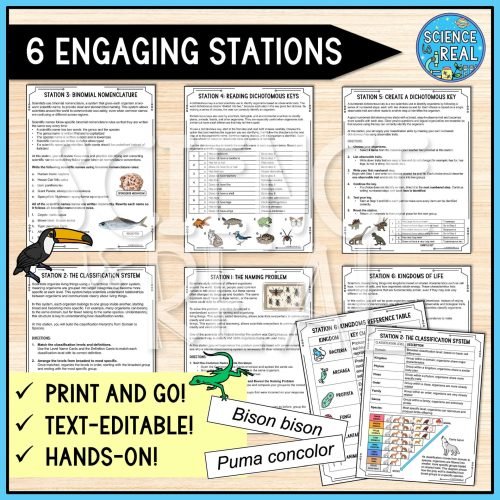
Station 1: Common vs. Scientific Names – Students complete a self-checking card activity to experience the problems scientists face when using common names and discover why a standardized scientific naming system is necessary.
Station 2: Levels of Classification – Students build the classification hierarchy from Domain to Species by matching and organizing classification levels, reinforcing how organisms are grouped from broad to specific.
Station 3: Binomial Nomenclature – Students review the rules of binomial nomenclature and practice identifying and correcting scientific names using proper capitalization and formatting.
Station 4: Using Dichotomous Keys – Students review how to read a dichotomous key and practice identifying organisms based on observable traits.
Station 5: Creating Dichotomous Keys – Students apply their understanding by creating their own dichotomous key using four classroom objects of their choice. This station is highly flexible and works especially well with plastic toys, lab items, or dollar-store objects.
Station 6: Kingdoms of Life – Students analyze trait-based organism descriptions and determine the correct kingdom for each one. A student-friendly reference sheet is included for scaffolding and support.
*Student handout also includes a small optional word search for brain breaks or early finishers.
Minimal Materials & Easy Prep
- With the included teacher’s guide and lesson plan, you will receive a stations overview page with each station’s overview and necessary materials needed to be placed at each station. You do not need station signage because each station card is clearly marked with the station number and name.
- You will need a small selection of objects for Station 5, where students create their own dichotomous key by choosing four items from the set you provide. To keep materials organized, it is recommended that the card sorts for Stations 1 and 2 be placed in envelopes. All other materials are included and ready to use.
Perfect for engaging students at the end of your classification unit, as a formative check within a unit, or as an in-depth review! Your download includes eight editable stations, editable student handouts, a helpful teacher’s guide, answer key, and a link to the Google Slides version of the activity.
Your Classification Stations Download Includes:
- Classification Stations Cards (text-editable PPT and PDF)
- Student Answer Sheet (text-editable PPT and PDF)
- Teacher’s Guide and Lesson Plan
- Original Content, Diagrams, Card Sorts, and Activities
- Answer Key
- Google Slides Version of the Activity
MORE CLASSIFICATION ACTIVITIES AND LESSONS
PURCHASE ON TPT